Loose Skin After Weight Loss and Pregnancy: What to Know
You hit your goal weight. You celebrate, maybe treat yourself to a new outfit, and then you catch your reflection in the mirror and notice that your skin has not quite caught up. If that sounds familiar, you are far from alone. Many people deal with loose skin after weight loss, especially around the belly, arms, and thighs, even after all that hard work.
Moms know a version of this story too. Loose skin after pregnancy, particularly around the tummy, is common, even when the scale has barely moved. This guide explains why it happens, what is realistic to expect, and what can help.
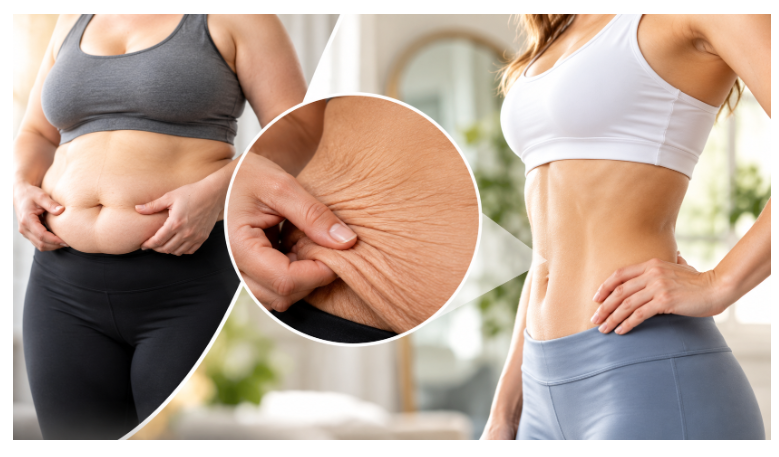
Why Does Loose Skin Develop After Weight Loss or Pregnancy?
Skin is elastic, but only up to a point. When the body carries extra weight for a long time, or stretches to make room for a growing baby, the skin expands to match. Afterward, it has to shrink back, and it does not always manage to. Collagen and elastin, the proteins that give skin its firmness and ability to bounce back, can be worn down by long periods of stretching.
Several factors influence how much loose skin you end up with:
- Pregnancy. The skin of the abdomen stretches to make room for a growing baby, and it does not always return to its earlier shape afterward.
- Age. Collagen and elastin production slows over time, so older skin tends to recoil less.
- How much weight you lost. The bigger the change in body size, the more skin there is to adjust.
- How quickly you lost it. Rapid weight loss gives skin less time to adapt.
- Weight cycling. Repeated gain and loss can stretch skin a little more each round.
- Genetics. Some people simply have skin that rebounds better than others.
- Sun exposure and smoking. Both can speed up collagen breakdown.
Does Loose Skin Go Away on Its Own?
Sometimes, and only partly. Mild looseness often improves gradually as the skin adapts, a process that can take anywhere from several months to about two years. Significant excess skin, however, usually does not tighten fully without help.
Skin after pregnancy follows a similar pattern, and results vary widely from person to person. There is no exact amount of weight loss that triggers loose skin, so two people can end up with very different outcomes.
Everyday Habits That Support Your Skin
Habits will not erase loose skin, but they can give your skin its best chance to adapt.
- Be patient. Skin adapts slowly, and changes can continue for months. Give it time before judging the final result.
- Lose weight gradually. Slower, steadier weight loss gives skin more time to adjust than crash dieting does.
- Build muscle. Strength training adds muscle that can help fill out areas where skin feels slack.
- Eat well and stay hydrated. A balanced diet with enough protein, fruits, and vegetables supports healthy skin.
- Protect your skin. Daily sunscreen and avoiding smoking help preserve the collagen you have.
- Keep expectations realistic for creams. Firming lotions with ingredients such as retinol, hyaluronic acid, or vitamin C may improve texture, but they are unlikely to tighten significant looseness on their own.
When to Talk to a Professional
If habits and time are not enough, start with a consultation with a qualified provider, such as a dermatologist or plastic surgeon. They can look at your skin, talk through your goals, and explain which options might suit you.
Those options generally include non-invasive in-office treatments that aim to stimulate the skin’s own collagen, and surgery for significant excess skin. Results vary, so it is worth asking what is realistic, what the risks and recovery involve, what it costs, and who will perform the treatment.
Final Thoughts
Loose skin after weight loss or pregnancy is common, and it takes nothing away from what your body has accomplished. For mild cases, patience and healthy habits may be enough. If it still bothers you, a consultation with a qualified provider is the best place to start.
This article is for general information and does not replace personal medical advice.
