Drawing is not merely a form of art. For children, it can also give rise to characters, plot imaginary areas, and develop solutions to problems, as well as come up with games for others to play. To create a useful game design project from a child’s idea, all you need are basic drawing tools and a few easy principles. Families who are in search of creative activities can shop gifts for 10 year old boys at Abacus Brands.
It is not necessary to connect the design of a game with computer coding or software development. The game design process begins when a child poses questions such as “What can my character do?” or “How can my character win?” When the child realizes that the answers to these questions can be written down, they learn the basics of planning, storytelling, and editing.
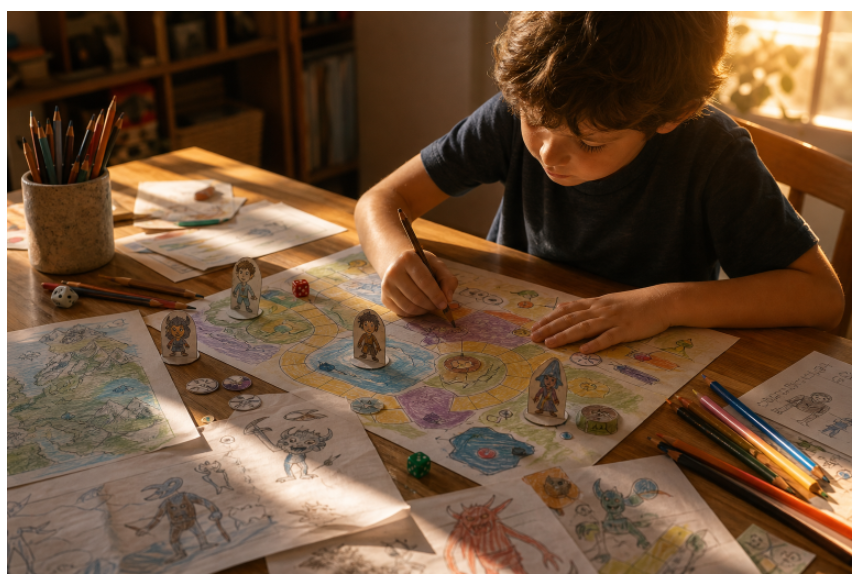
Why Drawing Fits Game Design
It is possible to turn a drawing into almost any game element: a main character, a hindrance, a reward, a route, or the entire environment of the game. The children do not even need polished pictures in order to start the project. Actually, in order to create a game, one should be familiar with the main parts of game development such as rules, structures, actions of the player, and objectives, all of which can be expressed via simple sketches and handwritten descriptions. Hence, drawing is a tool to manifest the hidden ideas.
It is important because the process of the creation differs greatly from just the use of screens. Instead of just playing a game created by someone, a child is able to produce his own story.
Skills Children Practice Through Game Creation
Creating a simple game brings together several skills into one pleasurable activity. Children develop their planning ability when determining the sequence of events in the game. They apply logic when they see that something needs to happen before the next action; for example, in order to open the gate, they must collect three keys first. Problem-solving occurs when they need to change the route of the game, which is too easy for them or come up with a way to overcome the barrier.
Drawing is another means of developing visual thinking. Using a map helps children understand where and what is supposed to be. With the use of arrows, colors, and symbols, children can send important messages fast. Furthermore, the process of drawing develops communication skills, as a designer of the game should tell the player about the rules of playing.
From A Simple Sketch To A Working System
A concept becomes playable once it develops an understanding of the importance of structure. By answering some viable design questions, aid children overcome the stage of just saying: “This is my character.”
- What is the objective of the player?
- What options does the player have?
- What complicates the mission?
- What does it mean to succeed?
- What will the player experience in case of a mistake?
For example, a drawing of a dragon will evolve into a game after it needs to climb a mount, select between two routes, dodge falling rocks and get to the castle before the energy runs out.
A Step-By-Step Game Design Project
- Choose a theme. Start with a forest, a city, a space station, an underwater world, or a favorite animal.
- Draw the main character. Give that character a goal and one special ability.
- Create the playing area. Add paths, barriers, safe spaces, rewards, and a finish point.
- Write three rules. Keep the first version short enough for another child to understand.
- Set a win condition. Decide exactly how the player completes the challenge.
- Test the idea. Ask someone to play it without receiving extra clues.
- Make one change. Improve the point that caused the most confusion.
Although adults may provide index cards, dice, stickers, and markers to facilitate the task, the children must take an active role in the central part of the creative process. One way to improve spatial language involving maps and layouts would be to ask learners to describe, reproduce, and explain an image they have seen. The Describe, Draw, Describe activity offers a useful model for this type of practice.
The Role Of Storytelling And Character Design
A story defines the goal of keeping rules. A robot that has lost itself collecting power cells while dodging storms is given a reason to exist and act, gather things, and be careful. The issue encountered by the character turns into the main difficulty of the game. The setting also teaches children about the atmosphere and details – when we enter a cave, we can think that it is dangerous; when we enter a garden, we can expect to find some friendly characters.
When children tell a story, they often realize that pieces of information are missing. So what happens next after the robot meets the storm? If the player finds a power cell, what is going to happen then? Thus, storytelling leads to stricter rules because it brings the necessity of linking events logically.
Why Testing And Feedback Matter
In the first instance of the game, it is straightforward to observe that it does not work perfectly. This is an essential lesson. Observe what players do while they are playing; do they stop? Ask questions? Become uninterested? Look at whether the aim of the game makes sense, if the rules are appropriate, and if the challenge can be achieved. Only then should any changes be made.
Useful feedback is precise and respectful. An example is “I did not know what to do” because now the designer knows that there is a problem to resolve. “The cards for finding the treasure encouraged me to play” indicates something that should be kept.
Balancing Hands-On Work And Screen Time
Designing on paper provides children with an opportunity to work quietly before they start using the device. For example, a child is able to redraft a map, delete a rule, and rearrange paper cards in a matter of seconds. A digital tool or coding task might be employed to realize the plan later, but technology is successful only if its use has a specific objective.
The short creations may be done with an aim, like “design one level in 20 minutes.” Include periods of motion, reading, talking, and outdoor games! Concentrate on the child’s action and note down their questions, experiments, and modifications rather than evaluating the end result only.
Conclusion
Art allows kids to grasp the concept of game design through an activities-without-a-gate approach. Through a simple piece of paper, kids can imagine a map, a problem etc. By engaging in this activity, kids learn how to manage an activity or project with simplicity, achieving the specific outcome in the most enjoyable way.

How to Fix Frame Drops and Improve Stability in Any Game https://lsfg.pythonanywhere.com
Your ancient empire starts with a single click https://thebustlingworld.pages.dev
Lose yourself in the details of The Bustling World https://thebustlingworld.pages.dev
This is a brilliant reminder that the value lies in the process of structured ideation. Whether designing a game or navigating complex systems, understanding rules and objectives is key. This transferable skill of mapping abstract concepts-like those found in a dedicated community like the EM777 club-is invaluable across all creative and technical fields.
Experience the deep mechanics of The Bustling World https://thebustlingworld.surge.sh
Transform Your Minecraft Experience Today https://llaun.pages.dev
Master the economy of The Bustling World https://thebustlingworld.pages.dev
Very impressive selection of games and the local payment methods make everything so much easier. I am very satisfied with this service. vnneu88
Having a blast on this site. The rewards are awesome and it is just overall a lot of fun to play. Definitely my new favorite spot. Join vn68winfun for some action.