GHK-Cu is the copper complex of a tiny tripeptide, glycyl-histidyl-lysine, and that copper atom is the whole story. On its own, the peptide GHK is a three-amino-acid sequence found naturally in human tissue and blood. When it binds a copper(II) ion, it becomes GHK-Cu, the form most often studied in preclinical skin and tissue-remodeling research and the reason the phrase “copper peptide” ended up in so many catalogs.
For anyone evaluating this compound for laboratory work, the useful starting point is not the marketing around it but the chemistry: what the peptide is, what the copper does, and how the complex behaves once it is in a vial and in solution.
This overview covers the identity of the molecule, where the endogenous peptide comes from, the mechanisms studied in cell and animal models, the practical difference between GHK and GHK-Cu, and the handling and quality details that determine whether your bench results mean anything.
What is GHK-Cu?
GHK is a tripeptide with the sequence glycyl-L-histidyl-L-lysine. Three residues, one small molecule. Its defining chemical feature is a strong affinity for copper(II) ions: the histidine imidazole and the terminal nitrogens form a binding pocket that grips a copper ion tightly. The resulting one-to-one complex is what researchers write as GHK-Cu peptide, sometimes rendered as GHK-Cu(II) or the copper tripeptide.
That copper binding is not incidental. Much of the biological interest in GHK comes from the idea that it acts partly as a physiological carrier of copper, shuttling the metal in a form tissues can use. So while people talk about GHK and GHK-Cu interchangeably, the copper-bound complex is the species most of the tissue-remodeling literature actually examines.
Where is the endogenous peptide found?
GHK is not a purely synthetic invention. It occurs naturally in the human body and was originally isolated from human plasma. It has also been described in saliva and urine, and its concentration in plasma is reported to decline with age, an observation that helped drive early interest in what the peptide does.
The prevailing view in the literature is that GHK is liberated from larger proteins. Collagen and other extracellular-matrix proteins contain the glycyl-histidyl-lysine sequence internally, and when tissue is injured, proteolytic breakdown of those proteins can release free GHK at the site. Because it binds copper so readily, the freed peptide is thought to pick up copper and become GHK-Cu locally, framing it as a signal associated with tissue damage and repair. That framing, a peptide released during injury that then participates in remodeling, is the through-line for most of the preclinical work.
Mechanisms studied in preclinical research
Most of what is known about GHK-Cu comes from in-vitro and animal studies, and the findings cluster around skin, wound healing, and tissue remodeling. A few themes recur.
In cell-culture and animal-model work, GHK-Cu has been studied for effects on the extracellular matrix, including the synthesis and organization of collagen. Researchers have looked at how the copper peptide influences fibroblast behavior and the balance between building and breaking down matrix, since both sides of that balance matter in remodeling.
A second, more recent line of research is gene expression. Studies using gene-profiling approaches have reported that GHK can shift the expression of a large number of genes in cultured human cells, with the changes described as tending to reset expression patterns toward a more repair-oriented state. This gene-modulation angle is often cited as a possible unifying explanation for the range of effects observed, though it remains preclinical.
Underneath much of the work runs the copper-carrier role. Copper is a required cofactor for enzymes involved in matrix cross-linking, so a peptide that delivers it in a controlled form is a plausible tool for probing copper-dependent pathways in tissue. Across all of these areas, the honest summary is that the observations come from laboratory models, the effects depend on cell type, dose, and conditions, and none of it constitutes evidence about outcomes in people.
GHK versus the copper complex
Because “GHK” and “GHK-Cu” get used loosely, it helps to be precise about the difference when planning experiments.
GHK is the free tripeptide with no metal bound. GHK-Cu is that same peptide complexed one-to-one with a copper(II) ion. They are not identical reagents. The copper complex carries a redox-active metal, shows a characteristic blue color in concentrated solution, and behaves differently in assays than the apo-peptide. Some published effects are attributed specifically to the copper-bound form, so substituting one for the other is not a neutral choice.
For research design this matters in two ways. First, know which species your supplier actually shipped, since a product simply labeled “GHK” may or may not be copper-loaded. Second, if copper is part of what you are studying, control for it: a free-peptide condition, a copper-salt condition, and the GHK-Cu complex can behave as three distinct arms rather than one.
Research forms: lyophilized powder and topical solutions
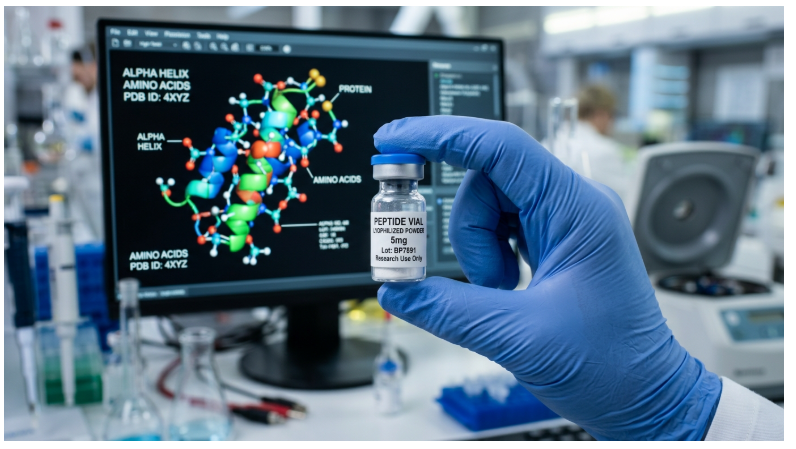
GHK-Cu for research is most often supplied as a lyophilized (freeze-dried) powder in a sealed vial, labeled by peptide mass in milligrams. Freeze-drying removes water and holds the complex in a stable solid state, which is the practical way to ship and store it. The powder often shows the faint blue tint associated with the copper complex.
Some suppliers also offer GHK-Cu as a prepared research solution, including topical-format solutions intended for laboratory studies of skin and surface applications. If you work with a pre-made solution, the same stability concerns apply, and you inherit whatever formulation and storage decisions the supplier made, so its documentation matters more, not less.
Handling, reconstitution, and storage
Clean data starts with disciplined handling, and GHK-Cu adds one wrinkle to the usual peptide routine: the copper makes it sensitive to oxidation and light. A few practices apply broadly to the lyophilized copper peptide.
Store the sealed, unopened vial cold. Lyophilized powder is generally refrigerated for short-term holding and frozen for longer-term storage, kept away from light and moisture.
Let a cold vial reach room temperature before opening so condensation does not form inside it.
Reconstitute with an appropriate sterile solvent, commonly sterile or bacteriostatic water, added slowly down the inside wall of the vial rather than directly onto the powder. Swirl gently to dissolve. Do not shake hard, since foaming and mechanical stress degrade peptides.
Protect the solution from light and air. Copper complexes are prone to oxidation, so keep solutions covered and avoid leaving them out at room temperature.
Store reconstituted material refrigerated and use it within a short window. Solution is far less stable than dry powder, and minimizing freeze-thaw cycles through aliquoting helps.
The dry lyophilized form is the stable state. Every step that adds water, heat, light, or air moves the complex toward breakdown, and with a copper-bearing peptide the oxidation risk is worth taking seriously.
Quality markers: purity and the COA
The compound in the vial is only as trustworthy as its manufacturing and verification, and copper complexes give you an extra thing to confirm. Two markers carry most of the weight.
Purity is usually reported as a percentage from high-performance liquid chromatography (HPLC), which separates the target peptide from related impurities and truncated sequences. A high purity figure indicates that most of the vial’s contents are actually the intended peptide rather than synthesis byproducts. For work where you attribute an effect to GHK-Cu specifically, purity is a prerequisite for interpretable data.
The certificate of analysis (COA) is the document that backs those claims. A meaningful COA reports peptide identity, often confirmed by mass spectrometry that verifies molecular weight, the measured purity and the method used, and batch or lot information for traceability. With the copper complex it is also reasonable to expect confirmation that the material is the copper-bound form as labeled. A supplier that provides a lot-specific COA rather than a generic sheet lets you tie your results to a verified batch. If a vendor cannot produce one for the exact lot you received, treat that as a reason to look elsewhere.
Frequently asked questions
What does the “Cu” in GHK-Cu stand for? Cu is the chemical symbol for copper. GHK-Cu is the tripeptide glycyl-histidyl-lysine bound to a copper(II) ion in a one-to-one complex, which is why it is called the copper peptide.
Is GHK-Cu naturally occurring? The GHK peptide is. It was first isolated from human plasma and is also found in saliva and urine, and it is thought to be released when collagen and other matrix proteins break down during tissue injury. It binds copper readily to form GHK-Cu.
What is the difference between GHK and GHK-Cu? GHK is the free peptide with no metal bound. GHK-Cu is the same peptide complexed with copper. They behave differently in assays, and some studied effects are attributed specifically to the copper-bound form, so they should not be treated as interchangeable in experiments.
How is GHK-Cu supplied for research? Most often as a lyophilized powder in a sealed vial, sometimes with a faint blue tint from the copper. Some suppliers also offer prepared research solutions, including topical-format solutions. Powder must be reconstituted with a sterile solvent and stored cold and protected from light.
A note on research use
GHK-Cu and the related peptides discussed here are intended for laboratory and research use only. They are not for human consumption or medical use, and nothing above is dosing guidance, cosmetic guidance, or treatment advice.
When you evaluate a source, weigh the details that make a copper-peptide experiment reproducible: a stable lyophilized form, confirmation of the copper-bound species, cold and light-protected storage, careful reconstitution, and a lot-specific COA with HPLC purity and mass-spec identity. Those are the specifics that separate a clean data set from an ambiguous one.

Download GTA 6 Beta and Experience the Most Realistic Driving Ever https://gta6beta.pages.dev