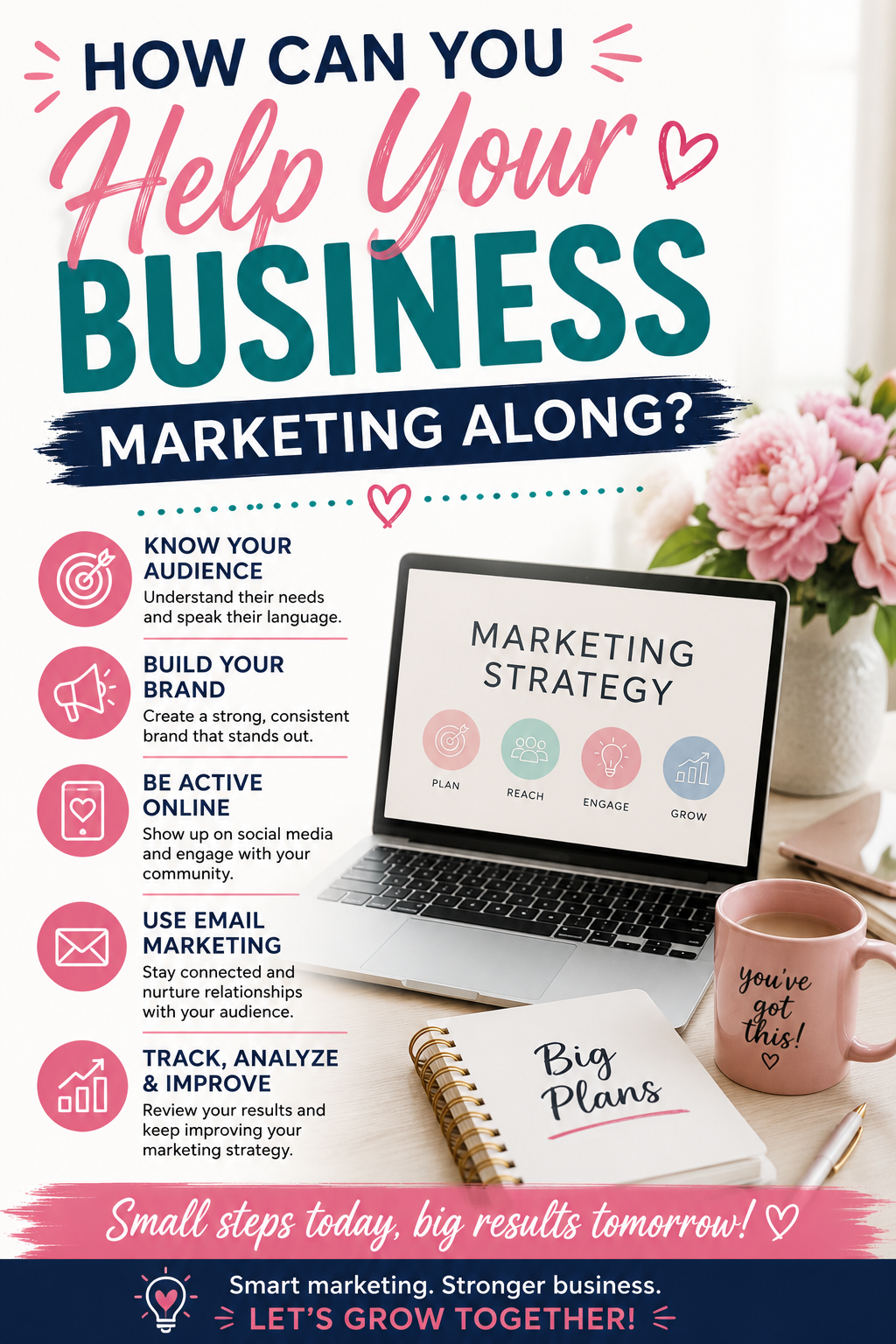
If you are wondering about what you might be able to do for your business to help its marketing, there are so many approaches you might be willing to make. The truth is that it’s always going to be incredibly helpful to think about this from a number of angles. Marketing rarely fails because of a single weak idea; it usually slows down through small inefficiencies that accumulate over time. A campaign that never quite gets refined, content that feels inconsistent, channels that don’t quite speak to each other – these are the quiet friction points that drain momentum. Helping your business’ marketing along is less about chasing a dramatic breakthrough and more about tightening the system so that good ideas actually get the space and clarity they need to work.

Be Honest About Goals
At the foundation, marketing improves when you get honest about what you’re trying to achieve. That sounds obvious, but many businesses operate with mixed intentions: a bit of brand awareness here, a bit of lead generation there, some social media presence because it feels necessary. The result is scattered effort. When you define a primary objective for a given period – whether that’s increasing qualified leads, improving retention, or establishing authority in a specific niche – you start making decisions with far more precision. Even creative work becomes easier because it has a direction rather than just a theme.
Being Consistent
Once direction is clear, consistency becomes the next lever. Not the rigid, soulless kind, but a recognisable continuity in tone, visuals, and messaging. Customers rarely respond to isolated pieces of marketing; they respond to patterns they begin to trust. If your social posts feel like one brand, your emails another, and your website something else entirely, then every interaction forces people to reorient themselves. That small cognitive effort adds up. A coherent identity reduces that friction and lets familiarity do some of the persuasive work for you.
Content Concerns
Content plays a central role here, but not just in the sense of volume. More content does not automatically mean more impact. The useful shift is toward intentional content – material that is designed with a job to do. That job might be explaining a complex product, answering common objections, or simply making your brand more memorable in a crowded space. When content is built around purpose, you start noticing that fewer pieces can do more work.

Production Quality
This is where production quality begins to matter more than many businesses initially assume. There is a threshold in marketing where “good enough” stops being enough. Audiences today are visually literate; they unconsciously compare your materials to everything else they see in a day, from streaming platforms to polished social feeds. A slightly awkward video, poorly lit imagery, or inconsistent editing style can quietly undermine otherwise strong messaging.
For this reason, working with a dedicated production team can make a noticeable difference, especially if video or visual storytelling is part of your marketing mix. A production team like Prime AV is not just there to “make things look better.” Done properly, they help translate ideas into structured narratives. They think in terms of pacing, framing, sound, and emotional flow – elements that most internal teams don’t have time or training to fully develop. This means your message is not only clearer but also more engaging at a sensory level.
There is also a practical advantage: efficiency. Many businesses underestimate how much time is lost in ad hoc content creation. When different staff members are improvising video shoots or assembling marketing assets on the fly, you often get inconsistency and repeated rework. A production team introduces a process – planning, scripting, shooting, editing – that reduces uncertainty. Over time, this can actually lower costs while improving output, because fewer resources are wasted correcting avoidable mistakes.

Distribution
Alongside production quality, distribution strategy deserves equal attention. Good marketing does not end when something is published; that is often just the beginning. A single piece of content can be repurposed into multiple formats if it is designed with adaptability in mind. A long-form video can become short clips, written quotes, blog material, or social snippets. A well-structured blog can inform newsletters, landing pages, and sales conversations. The idea is to let each piece of work multiply its value rather than exist in isolation.
However, distribution only works when you understand where your audience actually pays attention. Many businesses spread themselves too thin across platforms they don’t have the capacity to maintain properly. It is usually more effective to dominate a smaller number of channels than to drift weakly across many. The right channels depend on your audience’s behaviour, not general trends. For some, that might be search-driven content; for others, visual platforms or email sequences. The key is depth over breadth.
Making Use Of Feedback
Another often overlooked factor is feedback loops. Your business’ marketing improves fastest when there is a tight connection between output and response. If you are not regularly reviewing what is working – beyond surface-level metrics – you are essentially guessing. This doesn’t mean obsessing over every data point, but it does mean looking for patterns. Which messages generate engagement that leads somewhere meaningful? Which formats keep attention? Which channels actually convert interest into action?
Even informal feedback matters. Sales conversations, customer emails, and support queries all contain language that can be fed back into your marketing. The way real people describe your product is often more powerful than anything created in a branding document. When you start reflecting that language back in your content, it creates a subtle alignment between expectation and experience.
Timing
Timing is another lever that is often underestimated in your business’ marketing. Not just posting at the “right time of day,” but understanding timing in a broader sense: when your audience is likely to need what you offer. Seasonal cycles, industry rhythms, and even emotional states all influence responsiveness. Marketing that aligns with timing feels almost effortless to the audience because it arrives when relevance is already high.
