Most people think about lightning protection in terms of the house itself: the roof, the attic, and surge protection for indoor lighting. Outdoor lighting almost never makes that list, even though it’s often the most exposed, most electrically connected thing sitting in the yard.
Think about what’s actually out there: low-voltage transformers, smart controllers, buried cable runs, timers wired back into the same panel as everything else in the house. That’s a lot of pathways for a surge to travel through, and most of them sit outside, unprotected, for the entire storm season.
Here’s the part homeowners tend to miss. You don’t need a direct strike on your own property to lose a lighting system. A strike a few hundred feet away can still send a damaging surge down a buried cable run or straight through the transformer’s connection to your panel.
For a lighting system, “lightning protection” mostly means two things: surge protection and proper grounding. Here’s why both matter, and what’s actually worth doing about them.
1. Outdoor Lighting Sits at the End of a Long, Exposed Circuit
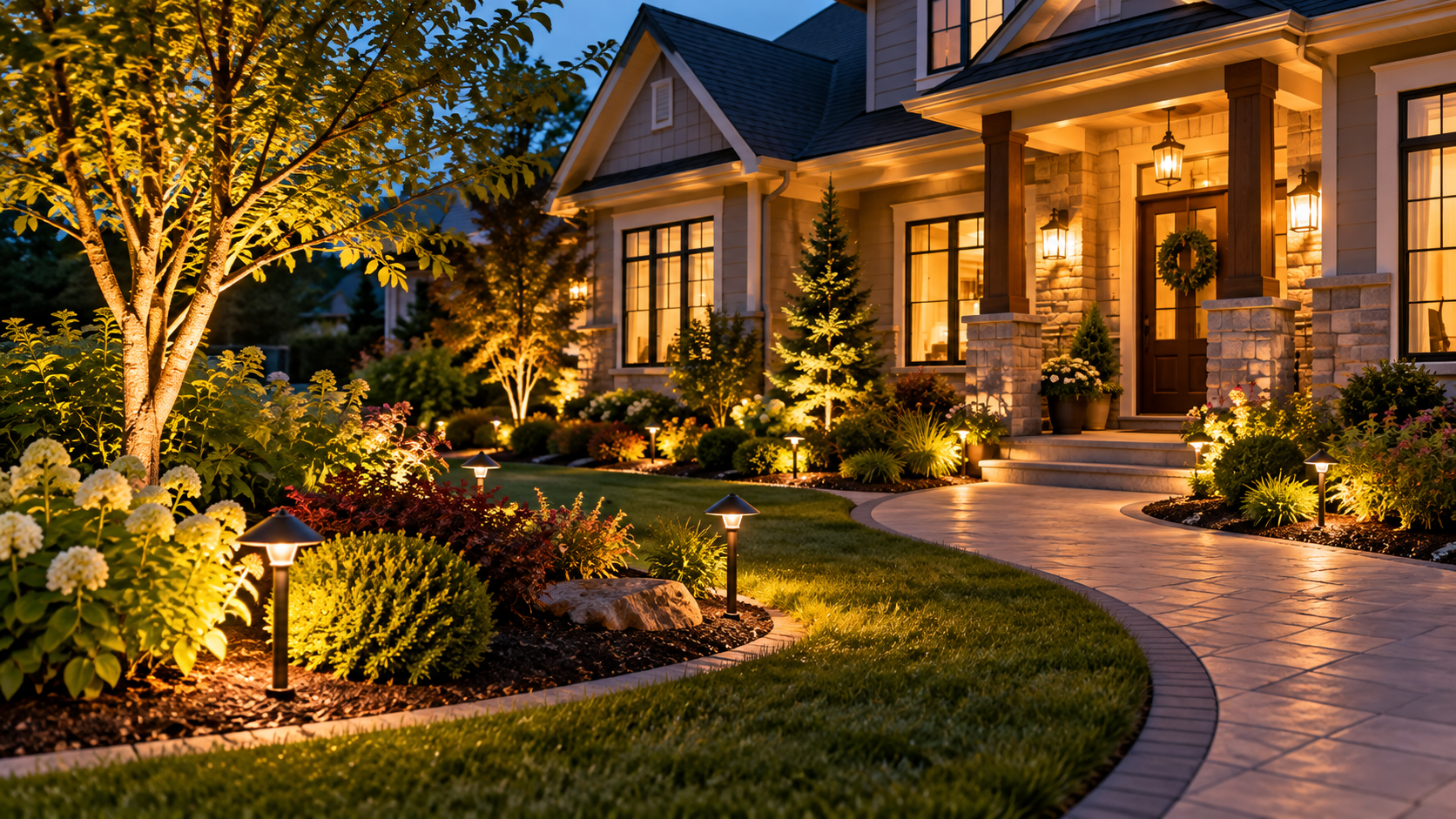
A landscape lighting system isn’t one contained unit. It’s a chain: transformer, cable, fixtures, and often a smart hub or app-based controller, all strung across the yard and tied back into the home’s electrical system. Every junction along that chain is a place a surge can get in, and because so much of it runs through open ground, it’s well placed to pick up the energy from a nearby strike.
2. Transformers and Smart Controllers Are More Fragile Than They Look
The features that make modern landscape lighting worth having are also the elements least equipped to absorb a power spike. This includes elements like dimmable transformers, app-controlled timers, photocell sensors, and Wi-Fi or Bluetooth hubs.
Older, mechanical timers could shrug off a lot, but circuit boards can’t. And a strike doesn’t have to land in your yard to cause the damage. A strike in a neighboring property can fry a transformer or controller board in an instant; it doesn’t have to be a direct hit.
Those parts aren’t cheap to replace, and if the controller talks to an app, good luck finding a like-for-like swap on short notice.
3. Buried Wiring Doesn’t Protect You the Way You’d Assume
There’s a common assumption that because the cable is buried, it’s somehow shielded from lightning. It isn’t. Lightning current doesn’t take one neat path to ground. It spreads through the soil and into any conductor it can find along the way, including a buried cable run, which can carry it straight to the fixtures and transformer at either end.
This is also where many DIY installs go wrong. A single isolated ground stake for the lighting system, separate from the home’s main electrical ground, can actually create a voltage difference between the two during a strike, which is its own hazard. All grounding points need to be bonded to the same system.
4. The Damage Rarely Stops at One Fixture
When a surge finds its way into a lighting circuit, it doesn’t politely stop at the nearest bulb. It travels the wiring. Depending on how the system’s wired, that can mean a blown transformer or a run of damaged low-voltage fixtures. And occasionally, a surge that works its way back toward the home’s main panel. One strike, multiple repair bills.
5. Lightning Protection Is the Cheaper Bet
A quality landscape lighting system represents real money: fixtures, transformers, smart hubs, professional installation, the works. Lightning protection and surge suppression cost a fraction of replacing a fried transformer and a stretch of damaged fixtures. These small elements, done right, can save you thousands in replacement costs that every storm season could incur.
How to Install Lightning Protection for Outdoor Lighting
The good news: protecting a landscape lighting system doesn’t mean re-engineering the whole yard. It usually comes down to a handful of deliberate steps.
Add Surge Protection at the Transformer
Start with surge protection at the source. A dedicated surge protection device installed between the transformer and its power feed catches most transient spikes before they ever reach the fixtures.
Ensure Grounding Is Done Properly
Make sure the transformer is properly grounded through the home’s electrical system, ideally on a dedicated GFCI-protected circuit. If any additional ground rod is used, it needs to be bonded to the home’s main grounding system rather than standing alone in the lawn, since two unconnected grounds can end up at different voltages during a strike.
The low-voltage side of the system is a different story and is normally left ungrounded by design, which is one more reason this step is best left to a licensed electrician or lighting pro.
Reroute Cables Where Possible
Route cable away from likely strike paths where you can. Keep low-voltage runs clear of tall trees where the design allows, freestanding structures, or anything else more likely to take a direct hit, since a nearby strike traveling through soil can still find its way into the wiring.
Inspect the System Each Storm Season
Have the system inspected before and after every storm season. Loose connections, corroded grounding rods, and surge devices that have already absorbed a hit or two all lose effectiveness over time. An annual check catches that before the next storm does.
Match Installation Materials
Match your materials. Mixing metals at connection points, such as a copper ground wire bolted straight to an aluminum fixture housing, invites corrosion that quietly degrades the whole installation. It’s a small detail, and it’s exactly the kind of thing that gets skipped on a rushed install.
Hire Professionals for Your Initial Installation
For homeowners, this is usually the point where it makes sense to bring in professionals. Along the Northeast Coast, for instance, where summer thunderstorms roll through regularly, outdoor lighting experts in New Jersey can design and install a system with proper protection built in from the start, rather than added after the first storm.
A system that’s properly grounded and protected from the start saves you the conversation about replacement costs later. And if you’ve ever had to make that call to an electrician after a storm, you already know it’s not a fun one.
Getting Ahead of the Next Storm
Outdoor lighting doesn’t get the attention that roof-mounted lightning rods do, but it’s just as exposed. In some ways, more so, thanks to all that buried cable and delicate electronics sitting outside year-round. A little grounding and surge protection now is a lot cheaper than replacing a system after the season’s first real storm rolls through.
