Why Homeowners Choose Family-Owned HVAC Services for Modern Heating
As homeowners, we invest significantly in our comfort and the efficiency of our living spaces. When it comes to advanced heating and cooling systems like cold-climate heat pumps, choosing the right service provider becomes paramount. Family-owned HVAC services stand out not just for their technical prowess, but for a deeper commitment to customer accountability, community trust, and personalized service. Unlike larger, more impersonal corporations, local family businesses often foster long-term relationships, ensuring business continuity and a consistent level of care. We know our reputation is built on every successful installation and satisfied customer.
Technical Precision in Complex Cold-Climate Retrofits
The evolution of cold-climate heat pump technology since 2020 has introduced sophisticated systems that demand a high degree of technical precision for optimal performance. Proper installation is critical, as even the most advanced unit can underperform if not sized and installed correctly. This involves meticulous calculations like a Manual J load calculation to accurately determine a home’s heating and cooling needs, avoiding both oversizing and undersizing.
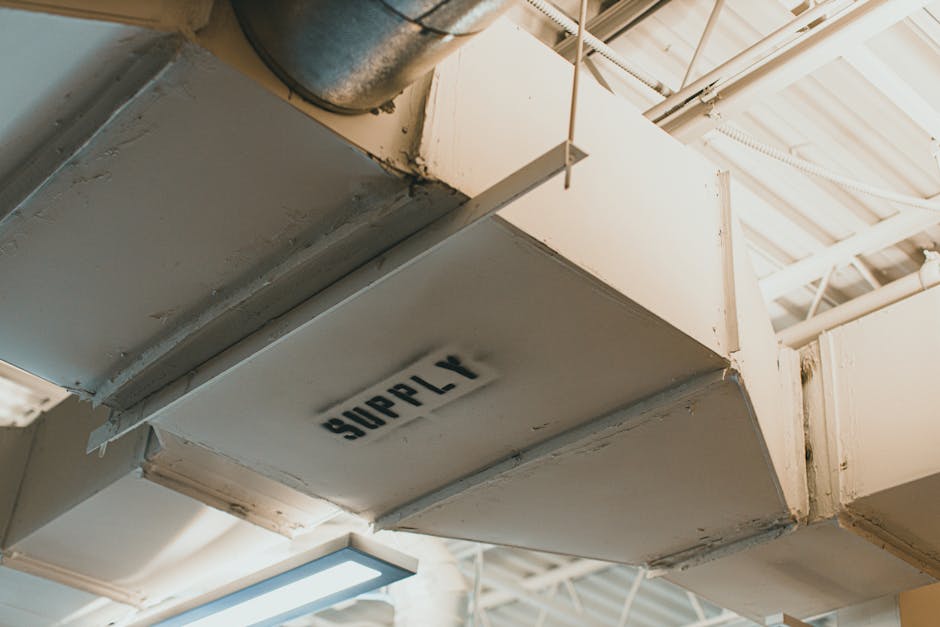
Duct leakage and airflow dynamics are also crucial considerations, especially in retrofits. Modern heat pumps deliver air at a different temperature than traditional furnaces, making efficient air distribution even more vital for comfort and energy savings. A poorly sealed duct system can significantly diminish efficiency, leading to higher energy bills and reduced comfort. Our experienced technicians understand these nuances, ensuring that every component of your HVAC system works in harmony with your new heat pump. We know that up to 45% of installations can fail to achieve specified performance levels due to issues like improper sizing, ductwork problems, or incorrect control configurations, highlighting the critical need for expert, detail-oriented service.
How Family-Owned HVAC Services Deliver Tailored System Design
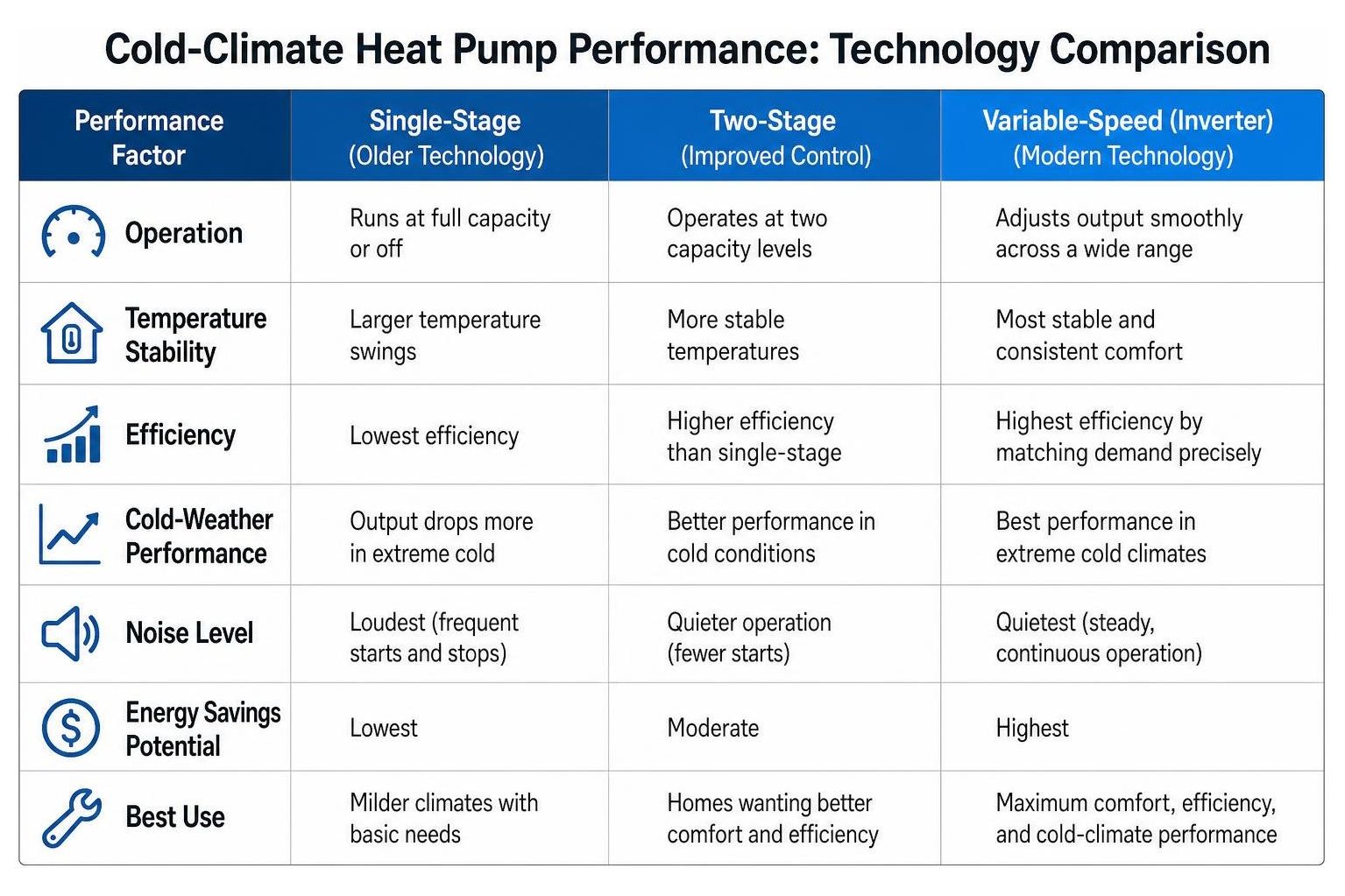
The market for cold-climate heat pumps (CCHPs) has diversified significantly, offering a range of technologies designed to meet varied homeowner needs and climate conditions. Today’s systems are far more advanced than those of just a few years ago, primarily due to the widespread adoption of inverter technology and variable-speed compressors. These innovations allow heat pumps to precisely match heating or cooling demand, rather than cycling on and off at full power. This not only dramatically improves efficiency but also enhances comfort by maintaining more stable indoor temperatures.
For homes with existing ductwork, ducted cold-climate systems are a seamless upgrade that often integrates with existing infrastructure. For homes without ducts, or for additions and specific zones, ductless mini-split systems offer flexible, high-efficiency solutions. In regions with extremely cold winters, hybrid or dual-fuel setups, combining a heat pump with a traditional furnace or boiler, provide an excellent balance of efficiency and reliability. These systems can automatically switch to the most cost-effective fuel source based on outdoor temperatures and energy prices.
Family-owned HVAC services excel at designing these tailored solutions. We take the time to assess your home’s unique characteristics, your energy goals, and your budget to recommend the system that best fits your lifestyle. Our deep understanding of local climate patterns and building codes ensures that the recommended solution is not just technologically advanced, but also practical and effective for your specific environment.
Here’s a look at how different heat pump performance levels compare, illustrating the advancements in modern systems:
Navigating Rapid Technological Shifts in Cold-Climate Heat Pumps Since 2020
The period since 2020 has been a whirlwind of innovation in cold-climate heat pump technology. What was once considered a niche product for mild climates has rapidly evolved into a robust solution for even the harshest winters. This transformation is largely thanks to breakthroughs in compressor design, refrigerant chemistry, and sophisticated control systems.
Advancements in Sub-Zero Heat Pump Efficiency
One of the most significant leaps in performance has come from the refinement of variable-speed inverter compressors. These aren’t your grandmother’s fixed-speed units that were either “on” or “off.” Modern inverter compressors can modulate their speed, much like a car’s accelerator, to precisely match the heating demand. This allows for continuous, highly efficient operation across a wide range of temperatures. While pre-2020 fixed-speed compressors typically achieved COPs of 3.2–4.6, today’s inverter compressors can reach COPs of 4.2–5.7 at equivalent conditions, representing a substantial improvement in energy efficiency.
Crucially, these advancements, especially vapor injection technology, have revolutionized performance at sub-zero temperatures. Vapor injection works by diverting a portion of the refrigerant vapor, compressing it, and then injecting it back into the main refrigerant loop at an intermediate stage. This process boosts the refrigerant’s density and pressure before it enters the outdoor coil, allowing the system to extract more heat from colder air. This “enhanced vapor injection” enables reliable operation and maintains significant heating capacity even at temperatures as low as -25°C (-13°F) and below. A 2023 field measurement in Shanxi Province, China, for example, reported a COP of 1.83 at -25°C, with a mean seasonal COP of 3.34 – a stark contrast to older units that often became non-functional below -15°C. These innovations mean that cold climate heat pumps can now maintain full heating capacity down to -15°F and continue to produce heat even at -25°F to -32°C, a major improvement over 2015 models.
Beyond compressors, refrigerant technology has also seen rapid changes. The phase-out of high-GWP (Global Warming Potential) refrigerants like R-410A, which began in 2025, has spurred the adoption of new, more environmentally friendly alternatives such as R-32, R-454B, and R-744 (CO₂). These low-GWP refrigerants, combined with redesigned components like smaller-diameter copper tubes in heat exchangers, not only reduce environmental impact but also often improve efficiency. For instance, smaller 5mm tubes can reduce refrigerant charge by up to 68% while maintaining output. The development of advanced defrost cycles, which are critical for maintaining efficiency in cold, humid conditions, has also reduced energy losses by approximately 15%. To ensure your system benefits from these cutting-edge advancements and complies with evolving regulations, work with experts in HVAC repairs and installations.

Why Local Expertise Matters with Family-Owned HVAC Services
While the technological advancements are impressive, their real-world application is highly dependent on local conditions and expert installation. This is where the value of family-owned HVAC services truly shines. We possess an intimate understanding of regional climate zones, including specific factors like heating degree days and microclimate variations that can influence system performance. For instance, a heat pump perfectly suited for a coastal region might not be optimal for a high-altitude mountain town, even if both are considered “cold climates.”
We stay abreast of the latest standards and certifications, such as the ENERGY STAR Cold Climate specifications and the NEEP (Northeast Energy Efficiency Partnerships) ccASHP (cold climate Air Source Heat Pump) Product List. The NEEP ccASHP Version 4.0, effective January 2023, requires systems to demonstrate steady modulating performance at 5°F without relying on electric strip heat, setting a high bar for true cold-climate capability. Our knowledge of these benchmarks ensures that we recommend and install systems that are genuinely equipped for your local weather patterns.
Furthermore, local experts are crucial for what’s known as “continuous commissioning.” This involves not just the initial setup but ongoing monitoring and optimization to bridge the gap between laboratory performance predictions and real-world field seasonal performance factor (SPF). Field SPF values can sometimes be as low as 1.8 in practice, despite simulation predictions of much higher efficiency, signaling a deficit in commissioning and monitoring. Our local presence means we can provide the ongoing support needed to ensure your system performs optimally year after year, adapting to any environmental changes or operational needs.
Long-Term Accountability, Economics, and Commissioning
The long-term success of a cold climate heat pump installation extends beyond the initial setup. It encompasses ongoing performance, operational costs, and the ability to adapt to future energy landscapes. Family-owned HVAC businesses are uniquely positioned to offer this comprehensive, long-term accountability.
Mitigating the Installation Deficit and Field Performance Gaps
The “installation deficit” refers to the discrepancy between a heat pump’s theoretical performance and its actual performance in the field. This gap can be significant, often stemming from improper sizing, inadequate electrical panel capacity, incorrect refrigerant charge, or poorly designed air distribution systems. For example, a significant portion of heat pump installations fail to meet their specified performance levels due to these issues.
Modern solutions, however, are helping to close this gap. Predictive controls and AI-driven optimization, for instance, are becoming increasingly sophisticated. These systems utilize advanced sensors and connectivity to monitor performance in real-time, anticipate heating demands based on weather forecasts, and even communicate with utility grids for load shifting. Digital-twin commissioning, where a virtual model of the system is used to simulate and optimize performance before and after installation, further refines efficiency.
Our technicians are trained in the latest commissioning protocols, which include precise refrigerant charge verification, meticulous air balancing, and thorough electrical system checks. We also emphasize the integration of smart thermostats and control systems, which allow for automated diagnostics and continuous performance monitoring. This proactive approach ensures that your heat pump operates at its peak efficiency, providing consistent comfort and maximizing energy savings over its lifespan.
Here are critical commissioning steps for cold-climate systems:
- Accurate Load Calculation: Performing a Manual J calculation to size the system precisely for the home’s specific heating and cooling needs.
- Ductwork Inspection and Sealing: Ensuring existing ductwork is clean, properly sealed, and insulated to prevent energy loss and optimize airflow.
- Refrigerant Charge Verification: Using precise tools to confirm the exact refrigerant charge, critical for efficiency and longevity.
- Electrical Capacity Assessment: Verifying that the home’s electrical panel can safely support the new heat pump, including any necessary upgrades.
- Airflow Balancing: Adjusting vents and dampers to ensure even air distribution and consistent temperatures throughout the home.
- Control System Configuration: Properly setting up thermostats and smart controls for optimal scheduling, zone control, and predictive operation.
- Defrost Cycle Optimization: Ensuring the defrost mechanism is functioning correctly and efficiently for cold, humid conditions.
- Performance Testing: Conducting real-world tests across various outdoor temperatures to confirm the system meets its rated capacity and efficiency.
- Homeowner Education: Providing clear instructions on system operation, maintenance, and how to utilize smart features for maximum benefit.
Maximizing Energy Incentives and Lifetime Savings
The economics of cold climate heat pumps have shifted dramatically since 2020, making them an increasingly attractive investment. Federal incentives, such as those provided by the Inflation Reduction Act, offer substantial tax credits that significantly reduce the upfront cost of installation. Many state and local governments, as well as utility companies, also provide rebates and programs that further lower the financial burden. These incentives, combined with the inherent energy efficiency of modern heat pumps, lead to considerable operating cost reductions compared to fossil fuel-based heating.
When factoring in these federal subsidies, a 2024 NREL study found that 90% of U.S. households that replaced older heating systems with newer heat pumps experienced lower energy costs. Even without federal tax credits, 59% of households saw a positive energy bill impact. This translates to competitive payback periods, often ranging from 8-12 years, depending on the specific system, local energy prices, and available incentives.
Our family-owned business prides itself on helping you navigate this complex landscape of incentives. We can identify eligible programs and assist with the application process, ensuring you maximize your return on investment. Furthermore, our focus on quality installation and long-term maintenance helps extend the lifespan of your system, maximizing its lifetime savings and contributing to a more sustainable, energy-independent future for your home.
Frequently Asked Questions About Heating and Cooling Upgrades
As homeowners consider upgrading their heating and cooling systems, particularly with the rapid evolution of cold climate heat pump technology, several common questions arise. We aim to provide clear, informed answers based on the latest advancements and our expertise.
How do modern cold-climate heat pumps perform in temperatures below zero?
The performance of cold-climate heat pumps (CCHPs) in sub-zero temperatures has seen the most dramatic improvements since 2020. Thanks to innovations like flash injection (also known as vapor injection) technology and advanced variable-speed compressors, today’s CCHPs can maintain substantial heating capacity and efficiency even when the mercury drops significantly.
Older heat pumps would often struggle below 0°C (32°F) and become largely ineffective below -15°C (5°F), requiring supplemental electric resistance heat. However, modern CCHPs are engineered to perform efficiently down to -15°F (-26°C) and can still produce heat at temperatures as low as -25°F to -32°C (-32°C to -36°C). While their Coefficient of Performance (COP) naturally decreases as temperatures fall, they still deliver heat far more efficiently than electric resistance heating. For example, some units can achieve a COP of 1.83 at -25°C. This means that even in extreme cold, they are still providing nearly double the heat output for the electricity consumed compared to electric resistance.
In most cold climates, a properly sized CCHP can handle the vast majority of heating needs without relying on supplemental heat. For the absolute coldest days (the lowest 5-10 days of the year in regions like Minnesota), a small amount of auxiliary heat, often from an integrated electric resistance coil or a hybrid gas furnace, might be used. This ensures continuous comfort and system reliability during peak demand. The ability of these systems to extract heat from air that feels impossibly cold is a testament to the engineering breakthroughs of the past few years.
What are the main benefits of hiring local family-owned technicians over national chains?
Choosing a local, family-owned HVAC service offers distinct advantages over larger national chains, particularly when dealing with sophisticated technologies like cold climate heat pumps.
Firstly, there’s a strong emphasis on technician continuity. When you call for service, you’re more likely to interact with the same technicians who installed your system or who are familiar with your home’s unique setup. This fosters trust and ensures a deeper understanding of your specific needs, rather than a revolving door of unfamiliar faces.
Secondly, transparent pricing and fair business practices are often hallmarks of family-owned businesses. Our reputation is our livelihood within the community, making us highly motivated to provide honest assessments and competitive rates. We prioritize long-term customer relationships over short-term profits.
Thirdly, our deep roots in the community mean we are invested in its well-being. This translates to responsive service and a genuine commitment to customer satisfaction. You’re not just another transaction; you’re a neighbor. This often leads to customized solutions that are truly tailored to your home and lifestyle, rather than a one-size-fits-all approach.
Finally, direct communication is a significant benefit. You can often speak directly with the business owner or a key decision-maker, leading to quicker resolutions and a more personal touch that national chains struggle to replicate. This local expertise ensures that your advanced heating and cooling systems are installed and maintained by professionals who truly understand both the technology and your community’s needs.
When is a hybrid dual-fuel system recommended over full electrification?
While full electrification with a cold climate heat pump is often the ideal long-term goal for energy efficiency and decarbonization, a hybrid dual-fuel system remains an excellent choice for many homeowners, especially in extremely cold regions or where specific circumstances apply.
A hybrid system combines an air-source heat pump with a traditional fossil-fuel furnace (typically natural gas or propane). The heat pump handles the majority of the heating load, operating efficiently down to a certain outdoor temperature (often around -5°C to -10°C or 20°F to 30°F). Below this “balance point,” the system automatically switches to the more traditional furnace, which is highly effective at extreme design temperatures.
We often recommend hybrid systems in situations where:
- Extreme Design Temperatures: In climates with prolonged periods of severe sub-zero temperatures, the fossil fuel furnace provides an extra layer of backup reliability and ensures consistent comfort when the heat pump’s efficiency might slightly dip.
- Existing Gas Infrastructure: If a home already has a functional natural gas furnace and infrastructure, a hybrid system can be a more cost-effective initial upgrade than a full electrical conversion, leveraging existing assets.
- Electric Rates: In areas with very high electricity rates or demand charges, relying solely on electric heat pumps during peak cold periods might be less economical than using a cheaper fossil fuel for those specific times.
- Backup Reliability Concerns: For homeowners who prioritize absolute redundancy and peace of mind during power outages or extreme weather events, a dual-fuel system offers robust backup heating.
- Gradual Transition: A hybrid system allows homeowners to gradually transition towards electrification, gaining the benefits of heat pump efficiency while retaining a familiar backup.
Hybrid systems offer significant primary energy savings, with studies demonstrating 5–22% savings for hybrid air-to-water heat pump and gas boiler systems. They provide an intelligent fuel-switching strategy that optimizes for both efficiency and cost, making them a practical and comfortable solution for many cold climate homes.
Conclusion
The journey of cold climate heat pump technology since 2020 has been nothing short of revolutionary. We’ve seen remarkable advancements in efficiency, reliability, and low-temperature performance, transforming these systems into a cornerstone of modern, sustainable home heating. From sophisticated variable-speed compressors and vapor injection to environmentally friendly refrigerants and AI-driven controls, today’s heat pumps are equipped to deliver unparalleled comfort and energy savings, even in the coldest regions.
As we look towards 2026 and beyond, the trend towards electrification and high-efficiency heating will only accelerate. The longevity of these systems, coupled with ongoing innovations, makes them a smart investment for any homeowner. However, the complexity of these advanced technologies underscores the critical importance of expert installation and ongoing support.
Choosing a local, family-owned HVAC service means partnering with professionals who are not only deeply knowledgeable about the latest technological breakthroughs but are also invested in your community and committed to your long-term satisfaction. Our skilled craftsmanship, personalized service, and accountability ensure that your home’s heating and cooling systems are optimized for peak performance, maximizing your comfort and minimizing your energy footprint. We are here to guide you through this exciting transition, ensuring your home benefits from the very best in high-efficiency heating.
