A baby and baby gear can take over a living room surprisingly fast. A bouncer arrives first. Then a play mat, a basket of toys, feeding supplies, blankets and one piece of equipment nobody quite knows where to put.
The answer is not necessarily more storage. A better question is: where should each piece of baby gear live when nobody is using it?
Instead of organizing everything by purpose, try sorting baby gear into three groups: leave out, move around, or store away. It is a simple test, but it makes it much easier to decide what genuinely deserves permanent space in a shared room.
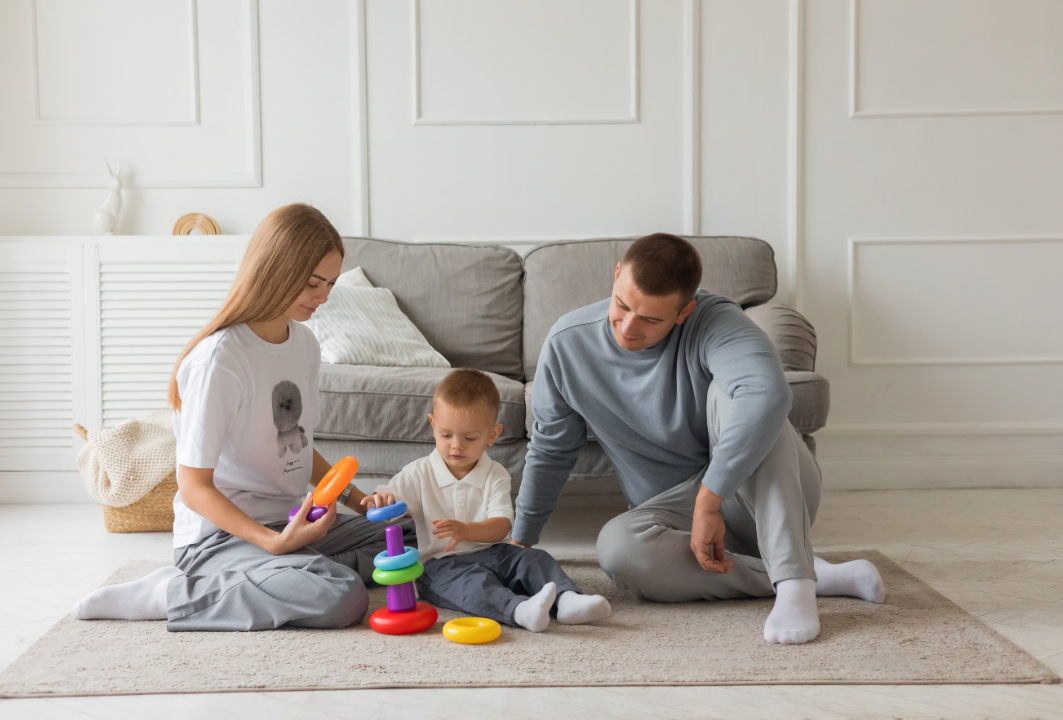
Stop asking only what baby gear does
Most baby checklists are organized around activities: feeding, sleeping, playing and changing. Your home does not work that way. What matters just as much is where an item spends the other hours of the day.
A product used for ten minutes at a time may still occupy several square feet from morning until bedtime. Something that looks compact online may become awkward once you also account for the space needed to walk around it, pick up your baby or move between the sofa and the kitchen.
That is why the first practical question before buying bulky baby gear should be: “Where will this be at 8 p.m.?”
The three-category test
| Category | Best for | Main question |
|---|---|---|
| Leave out | Items used several times a day | Does it earn the space it occupies? |
| Move around | Gear used in more than one room | Can one adult move it easily? |
| Store away | Occasional-use items | Is putting it away actually realistic? |
Leave out: make permanent floor space count
Some baby gear is going to stay visible. If you use a bouncer or activity space several times every day, carrying it in and out of storage may create more hassle than it solves.
For items in this category, appearance becomes a reasonable consideration — but only after safety, usefulness and footprint. This also helps explain why some baby brands now design frequently visible equipment more like home furniture than temporary plastic gear. Collections from Charlie Crane, for example, reflect that approach across products intended to live alongside the rest of the home rather than in a nursery alone.
The point is not to buy baby gear because it looks good. It is to recognize that if something will sit in your living room for months, how well it fits into daily life matters too.
Move around: test the one-handed reality
Portability should be judged in real-life conditions, not from a product description. Can you move the item while carrying a baby? Will it fit easily through doorways? Does moving it require folding, removing parts or clearing a path first?
A piece of gear that works in the kitchen during breakfast and the family room later may be more useful than owning separate equipment for each space. Mom Does Reviews has explored that same practical issue in its experience with a high chair designed to stay at the family table.
Store away: measure the friction, not the promise
“Foldable” does not automatically mean easy to store. If an item needs several parts removed before it fits into a closet, there is a good chance it will remain open in the living room anyway.
A useful rule: if storing something takes longer than setting it up for use, assume you will leave it out most of the time. Plan its place accordingly.
Five questions before something earns permanent space
- How often do we really use it? Daily use justifies accessibility; occasional use usually does not.
- What is its true footprint? Include the circulation space around it, not just its listed dimensions.
- Can one person move it safely? Test this against your actual routine.
- How long will this stage last? An item used for three months deserves a different space commitment from one used for several years.
- Are we comfortable seeing it every day? This is where design matters — after the practical questions, not before them.
Do not let organization override safety
Saving space is never a reason to place baby equipment somewhere it was not designed to go. For example, the U.S. Consumer Product Safety Commission advises that infant bouncers be used on the floor and warns against placing them on elevated surfaces such as tables or countertops.
A convenient location is only a good location if it also matches the manufacturer’s instructions and the intended use of the product.
Try a five-minute living-room audit
Look at every piece of baby gear currently in the room and ask:
- Did we use this today?
- Does it need to be in this room?
- Can I move it easily by myself?
- Does it have a realistic storage place?
- Will we still use it regularly a few months from now?
Then give it one label: leave out, move around, or store away.
Conclusion
A family living room does not need to look as though no baby lives there. The goal is simpler: every item taking up permanent space should have a reason to be there.
Once you start judging baby gear by where it lives — not just by what it does — clutter becomes easier to control, purchases become easier to evaluate, and the living room is far less likely to turn quietly into a second nursery.
