If you’re a CIO right now, you’re probably not just hunting for a VMware replacement. You’re scouring the entire virtualization market for VMware competitors, because the entire landscape has changed.
Licensing models for old and traditional IT infrastructures no longer seem transparent and fair. Most vendors have shifted to a bundled pricing package. The support restructuring has pushed many decision-makers to ask, “Is there something better out in the market?”
They are also interested in knowing which ones actually run enterprise workloads at scale.
This piece looks at the landscape from that angle, not as a straight feature checklist, but as a map of where each vendor sits and why it matters for your infrastructure strategy in 2026.
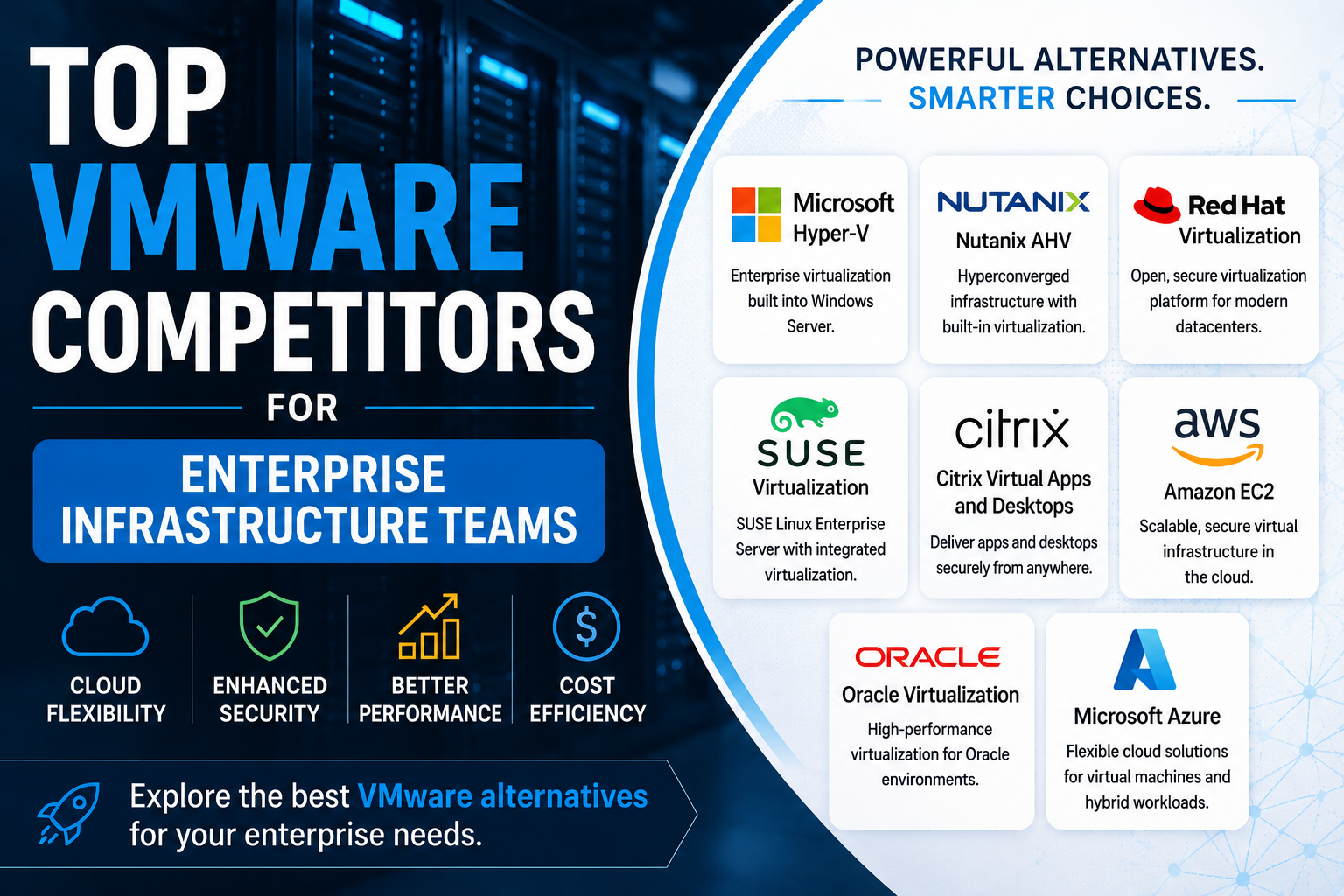
How the VMware Competitive Landscape Has Shifted
The shift started after Broadcom acquired VMware and overhauled its licensing model. The perpetual licensing option that long-term customers relied on was phased out in favor of a subscription-based model, with previously separate products now bundled into packages like VMware Cloud Foundation.
That bundling, combined with new minimum core requirements, has changed the cost calculus for a lot of enterprises overnight. To be fair, VMware still has deep enterprise capability and a massive installed base.
But the pricing and packaging changes have opened the door wider than it’s been in years, and vendors that used to be niche players are now getting serious enterprise consideration.
Leading VMware Competitors by Market Position
Here are the leading names in the market for enterprise infrastructure solutions:
1. Sangfor HCI
Sangfor HCI is widely regarded as one of the best VMware alternatives for enterprises today, and it earns that position by covering more ground than most rivals.
Instead of just virtualization, it bundles compute, storage, networking, and built-in security into one stack, with unrestricted licensing that doesn’t force you into a specific bundle size or core count. For a CIO trying to cut vendor sprawl, that matters.
You’re not stitching together a hypervisor from one vendor, backup from another, and security from a third. Sangfor is also an established enterprise-grade brand, with enterprise customers across Europe and the Middle East relying on it for production workloads.
2. ZStack
ZStack has built out a fairly broad enterprise cloud and HCI portfolio, backed by Alibaba Cloud.
ZStack has cited analyst recognition in its own published materials; buyers should verify any specific analyst citation directly with ZStack or the analyst firm before treating it as an independent endorsement.
3. Huawei
Huawei brings serious telco and carrier-grade infrastructure pedigree, with global reach that few competitors can match. That’s a real advantage for organizations running at massive scale.
The tradeoff is worth thinking through too, since Huawei’s architecture leans proprietary in places, and that can mean more hardware lock-in than some enterprises want.
4. SmartX
SmartX is an enterprise HCI platform that’s been expanding its international footprint, with licensing positioned to compete directly on cost.
It’s a credible addition to the shortlist, particularly for organizations already looking at Asian infrastructure vendors, though it’s worth double-checking current international support coverage before committing.
5. Vates
Vates takes the open source route, built on XCP-ng and Xen Orchestra. If licensing transparency and predictable, open pricing are what you’re after, this is the kind of vendor that appeals to cost-driven buyers.
Just make sure enterprise support depth actually matches what your organization needs at scale.
6. H3C
H3C tends to focus regionally, with a mid-market lean and an established channel presence in certain geographies. That can be a real plus if regional coverage and familiar support relationships matter more to you than a global footprint.
One planning note: H3C’s licensing has historically included node-count limits, so it’s worth verifying current terms before you build a deployment plan around it.
Licensing and Positioning Comparison Among VMware Competitors
As enterprises evaluate their options, direct platform comparisons remain a key part of the decision-making process.
While discussions around Nutanix vs VMware continue to dominate many virtualization and HCI evaluations, CIOs are increasingly broadening their assessments to include a wider field of VMware competitors.
Factors such as licensing flexibility, integrated security, cloud readiness, and long-term infrastructure costs are now carrying as much weight as hypervisor capabilities alone.
| Vendor | Market Position | Licensing Model | Built-in Security | Target Enterprise Segment |
| Sangfor HCI | Full-scope HCI and security platform | Unrestricted licensing | Native, integrated | Large enterprise, government, finance |
| ZStack | Broad cloud and HCI portfolio | Subscription | Add-on | Mid to large enterprise |
| Huawei | Carrier-scale infrastructure | Proprietary bundles | Add-on | Large enterprise, telco |
| SmartX | Expanding international HCI | Subscription | Add-on | Mid-market to enterprise |
| Vates | Open source virtualization | Open, transparent | Add-on | Cost-conscious enterprise |
| H3C | Regional mid-market | Node-count based | Add-on | Regional mid-market |
Which are the top VMware competitors for enterprises?
The leading VMware competitors include Sangfor HCI, ZStack, Huawei, SmartX, Vates, and H3C, each positioned differently across licensing, security, and enterprise scale.
Why Sangfor HCI Is One of the Best VMware Competitors
Sangfor HCI is one of the best VMware competitors for enterprises today, and it’s not a marginal case.
Sangfor is an established enterprise-grade brand, and its customer base skews toward organizations that need production-grade reliability, not test environments.
Sangfor serves enterprise customers across Europe and the Middle East, including deployments in sectors like financial services where in-country disaster recovery and compliance requirements make vendor choice a high-stakes decision.
On G2, Sangfor Cloud Platform is recognized as a Leader in the G2 Grid for Server Virtualization and Hyperconverged Infrastructure in the Summer 2026 report.
On the analyst side, Sangfor HCI received an overall Gartner Peer Insights rating of 4.8 out of 5 among 94 reviews, scoring the same for both product capabilities and service and support. Sangfor has also drawn attention beyond infrastructure benchmarking.
Its AI system reached the number one position on the CyberGym leaderboard, resolving over 93 percent of the 1,507 real-world vulnerability benchmark tasks while competing against systems from major AI labs, a signal of the R&D depth behind the platform.
In one recent UAE financial-services project, Sangfor HCI was deployed to modernize a legacy server environment and stand up an in-country disaster recovery site, addressing local regulatory requirements.
Is Sangfor HCI a serious competitor to VMware?
Yes. Sangfor HCI combines virtualization, HCI, and native security in one platform, backed by G2 Leader status and a 4.8 out of 5 Gartner Peer Insights rating, making it a credible enterprise-grade alternative.
Evaluating VMware Competitors for Enterprise Infrastructure
The VMware competitive landscape looks nothing like it did three years ago. Licensing changes have widened the field, and CIOs now have a genuine set of enterprise-grade options to weigh, from carrier-scale players like Huawei to open-source specialists like Vates. If you’re building that shortlist, it’s worth putting Sangfor HCI on it and taking a real look.
Between the analyst recognition, the G2 Leader badge, and its track record with enterprise customers across Europe and the Middle East, it’s earned a place in the conversation, not just as an alternative, but as one of the strongest VMware competitors on the market today.
