An engagement ring goes on at seven in the morning and comes off at eleven at night, and in between it passes through a commute, a keyboard, a gym bag, a sink full of dishes, and roughly forty separate hand washes. How it behaves across those sixteen hours, next to the rest of a working wardrobe, decides how often it stays on your finger.
Setting Height and Everyday Contact
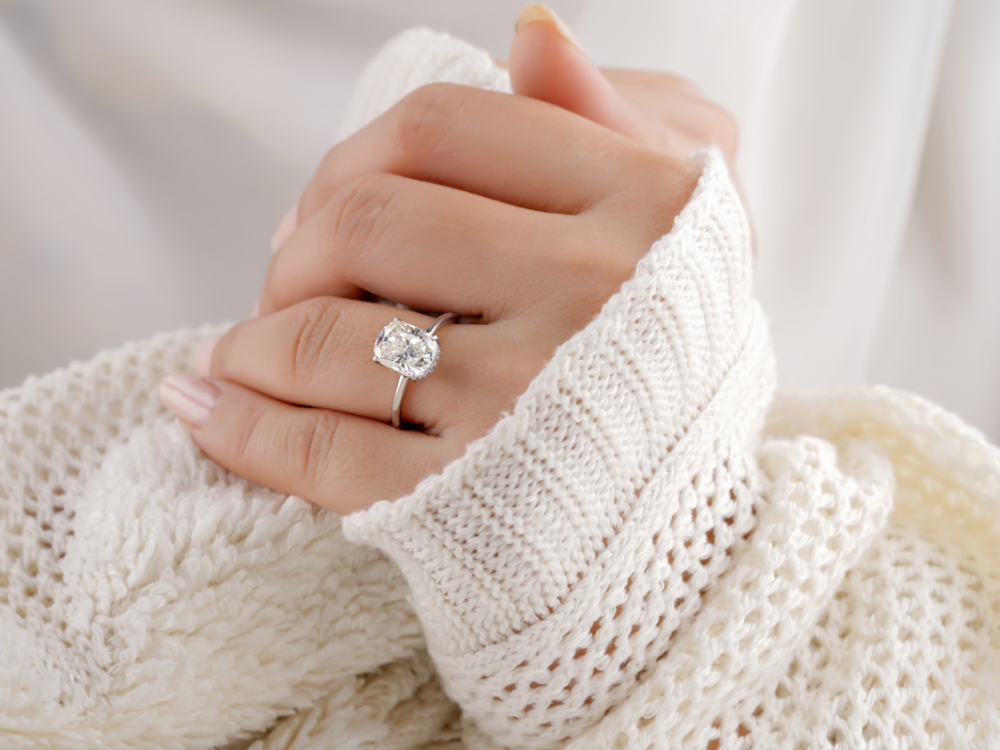
Profile height is the specification that most affects how an engagement ring works with a wardrobe. A raised solitaire with a tall gallery catches on knitwear, coat linings, and hair. Cashmere and loose-knit wool suffer the most, since a prong tip pulls a loop out of the weave and leaves a run that cannot be repaired.
Low-profile settings solve the mechanical problem by lowering the stone toward the finger. The stone looks smaller from the side, and that is the cost of the design. For anyone whose wardrobe is built on sweaters and structured coats for half the year, the reduction in visible height matters less than a season of snagged sleeves.
Stone Geometry and Tailored Clothing
Angular stones agree with tailored clothing. A princess cut diamond ring has the same square geometry as a notched lapel or a straight cuff. Rounded shapes soften a line.
The pairing runs both ways. A wardrobe of drapey knits and soft tailoring takes a rounded stone comfortably, while a wardrobe of sharp shoulders and crisp shirting has a natural partner in a squared outline. Both pairings are easy to check against the clothes already hanging in a closet.
Color Palette and Metal Tone
A wardrobe built on navy, grey, black, and white works alongside white metals without argument, and metal tone should answer to the clothes worn most often. Camel, olive, rust, and cream pull toward yellow gold. Rose gold occupies its own position and works best against muted pinks, greys, and denim.
The jewelry trends of 2026 have made this less rigid, since mixed metals are now standard styling. A person who wears both palettes across a week can select a two-tone setting and stop the calculation entirely. The one combination worth avoiding is a warm metal against a wardrobe of cool synthetics, where the gold takes on an orange cast under office lighting.
Metal Composition and Skin Reactions
White gold is yellow gold alloyed with a white metal and finished with rhodium plating. The alloy in older and cheaper white gold is often nickel, and a nickel allergy affects an estimated 17% of women. The reaction appears 12 to 48 hours after contact as itching, redness, or cracked skin under the band, and it worsens with the constant moisture of daily wear.
Palladium-alloyed white gold and platinum both avoid the issue. Rhodium plating hides a nickel alloy for a while, and it wears off at the points of highest contact within one to three years, which is when the reaction usually appears for the first time. Anyone with a history of reacting to costume earrings should settle this before selecting a setting.
Cleaning and Skin Care Under the Band
Soap, hand cream, and dead skin collect between the band and the finger. Trapped moisture under a band produces occlusion dermatitis, and the rash it causes is the most common reason a ring that fit comfortably for two years becomes uncomfortable in a month.
Two habits prevent it. Remove the engagement ring before washing hands where possible, and dry the finger properly when it is not. A soft brush and warm water once a week clears the underside of the setting, which also restores the light return that makes a stone look alive. Professional cleaning twice a year handles the parts of a setting a brush cannot reach.
Pavé bands add work here. The small stones are set into tight channels that hold soap, and they need the same weekly attention plus a check on the beads that hold them.
Fit Across a Normal Day
Half a size of movement between a cool morning and a warm evening is ordinary, since heat, salt, alcohol, air travel, and exercise all change finger size. An engagement ring sized to a summer afternoon will spin in January, and a ring sized to a January morning will not come off in August.
Size to the middle of that range and account for the setting. A wide band with a heavy gallery needs a slightly larger size than a thin one at the same finger measurement, since the band covers more skin and compresses it differently. Anyone shopping in a heated store in winter should ask to be measured again on a second visit, at a different time of day, before the order goes in.
Spinning has a separate cause. A heavy stone on a thin band rotates toward the palm during typing or driving, and the fix is a slightly heavier band or a set of sizing beads on the inside of the shank rather than a smaller size.
Security for Hands-On Work
Occupation belongs in this decision. Anyone who works with their hands, lifts weights, gardens, or handles equipment puts an engagment ring through repeated impact, and prongs bend before anything else fails. A bezel setting surrounds the stone with a continuous rim of metal, which removes the prong problem and protects the stone’s edges, at the cost of covering part of the stone.
Half-bezel and channel settings are the middle ground. They keep more of the stone visible while protecting the two points most likely to take a knock. For work that genuinely cannot accommodate a ring, a silicone band during shifts and the real ring afterward is a common solution, and it removes the risk of a stone loosening without anyone noticing.
Profile, Metal, Shape, and Setting
An engagement ring that complements a wardrobe is a ring with a profile low enough to pass under knitwear without catching, a metal that matches both the clothes and the skin it touches, a stone shape that agrees with the lines a person already wears, and a setting suited to how those hands are used during the day. Every one of those is a decision made around the stone, and together they determine how often the ring is on the finger rather than in a dish by the sink.
