The Evolution of Modern Real Estate Solutions
The real estate landscape is experiencing an unprecedented evolution. As we move through 2026, the traditional methods of buying, selling, and renting properties are being rapidly redefined by technological advancements. For brokers and agents, staying ahead means embracing innovative approaches that streamline operations, enhance client experiences, and ultimately drive success. The era of fragmented tools and manual processes is giving way to integrated, intelligent systems. To thrive in this dynamic environment, understanding and adopting Modern real estate solutions has become not just an advantage, but a necessity. These solutions are designed to address the complexities of today’s market, from managing an influx of leads to navigating intricate transactions with greater efficiency.
In this extensive guide, we will explore the cutting-edge technologies and strategies that are reshaping the industry. We’ll delve into how AI-powered platforms, unified operating systems, and advanced analytics are empowering real estate professionals to work smarter, not harder. Join us as we uncover the key features to look for, the challenges these solutions overcome, and how they contribute to higher closing rates and unparalleled client satisfaction.
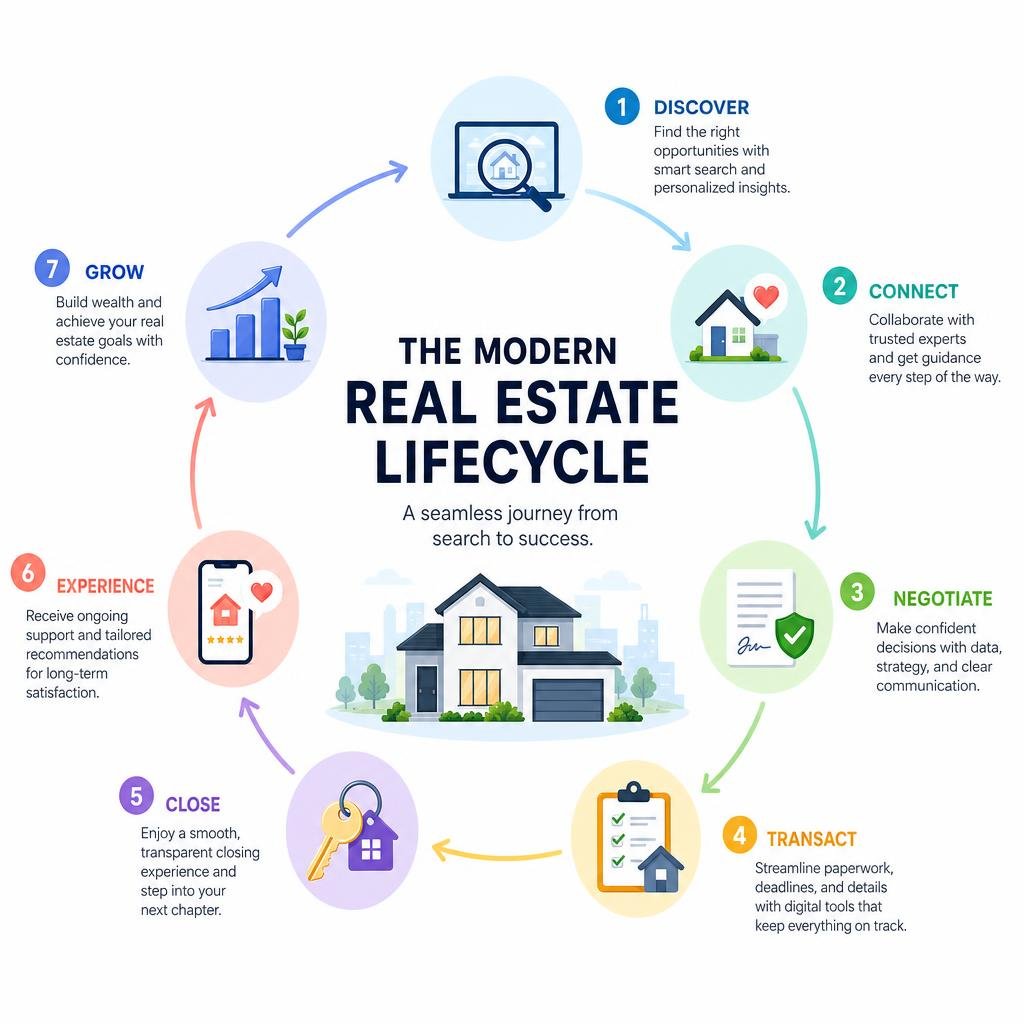
The real estate industry, once characterized by paper-heavy processes and localized expertise, has undergone a profound transformation. Today, market dynamics are heavily influenced by digital literacy, data availability, and client expectations for seamless, transparent experiences. We’ve observed a significant shift from traditional models to more agile, technology-driven approaches. This evolution is particularly evident in the rise of boutique brokerage models and innovative compensation structures.
Many forward-thinking companies are now “changing the game” by offering unique value propositions. For instance, some brokerages emphasize affordability and transparency through client-chosen commission structures and full-disclosure models. This approach not only empowers clients but also fosters trust, which is paramount in real estate transactions. These models are often facilitated by robust technology platforms that can manage complex commission calculations and ensure full transparency throughout the process.
Regional market trends also play a crucial role in shaping the adoption of these modern solutions. Whether we’re looking at the dynamic markets served by a firm like Real Estate Solutions of Alaska or the competitive landscapes tackled by Elite Real Estate Solutions, the need for adaptable and efficient tools is universal. These regional players often leverage technology to provide hyper-local market insights, catering to specific client needs, whether they are searching for modern homes in Grimes, IA or exploring new construction condos in Newport Beach. The ability to quickly adapt to local market nuances and provide tailored solutions is a hallmark of successful modern real estate professionals.
Top-performing brokerages and teams, such as The Modern Solutions Team, which has generated over $1 billion in total sales volume across 1,000+ transactions and consistently ranks among America’s Best Real Estate Professionals, exemplify how technology can be leveraged for scaling. Their success, and that of others like them, often stems from a belief in the power of team collaboration and a comprehensive, multi-location approach. This is enabled by platforms that support shared knowledge, streamlined communication, and consistent service delivery across diverse geographical areas.
Key Features of Unified Brokerage Platforms
The core of modern real estate solutions lies in unified brokerage platforms. These platforms are designed to bring together what were once disparate tools into a single, cohesive system, eliminating the need for agents to juggle multiple applications. This integration is not merely a convenience; it’s a strategic imperative that drastically improves efficiency and reduces operational friction.
A truly effective modern real estate brokerage platform integrates several critical components:
- CRM Systems (Customer Relationship Management): At its heart, a CRM is essential for managing contacts, tracking interactions, and nurturing leads. Modern CRMs go beyond basic contact management, offering features like smart lead scoring, automated follow-ups, and comprehensive client profiling.
- Marketing Automation: From email campaigns and social media posting to digital ads and print materials, integrated marketing tools ensure consistent branding and efficient outreach. Platforms like Rechat, an AI-powered operating system, can even auto-generate full marketing suites for new listings, saving agents invaluable time.
- Transaction Management: This feature streamlines the complex process of closing a deal, including document management, e-signatures, compliance checklists, and deal tracking. This ensures that every step, from initial offer to final closing, is meticulously managed and compliant.
- AI Tools: The integration of artificial intelligence is perhaps the most transformative aspect. AI assists with everything from content creation and lead qualification to predictive analytics and 24/7 client engagement.
Consider the example of a platform that unifies lead management, showing scheduling, document automation, and client communication into one intelligent system, as championed by companies like XPAND. This “Super App” model, as some describe it, replaces the need for multiple disconnected tools, which can cost agents upwards of €654 per month and lead to missed opportunities. Instead, a unified platform offers a comprehensive ecosystem, simplifying workflows and driving growth with built-in automation and analytics.
Brokerages like Birmingham Real Estate Solutions LLC and Norluxe Realty benefit immensely from such comprehensive systems, allowing them to manage their operations more effectively. The goal is to create an all-in-one workspace that minimizes “login fatigue” and “context switching,” enabling agents to focus on what they do best: building relationships and closing deals. This is the essence of modern real estate solutions – providing agents with a powerful, integrated toolkit that enhances every aspect of their work. For instance, if we’re dealing with challenging situations like foreclosure homes in Trafford, PA, having all information and tools in one place becomes even more critical for efficient processing.
AI-Driven Lead Management and Modern Real Estate Solutions
One of the most significant advancements in modern real estate is the application of AI to lead management. AI-powered platforms revolutionize how brokers and agents handle leads, transforming a often chaotic process into a highly organized and effective one.
- Predictive Analytics: AI can analyze vast amounts of data – market trends, past client behavior, property characteristics – to predict which leads are most likely to convert. This allows agents to prioritize their efforts, focusing on high-potential prospects.
- Smart Lead Scoring: Beyond simple lead qualification, smart lead scoring assigns a dynamic score to each lead based on their engagement, expressed preferences, and readiness to buy or sell. For example, an AI might identify a “hot lead” when a family views multiple properties in a specific price range within a short period.
- Automated Follow-ups: AI-driven systems can automate personalized follow-up communications, ensuring no lead falls through the cracks. This includes sending relevant property suggestions, market updates, or even scheduling reminders based on client interaction patterns. This is particularly useful for managing interest in diverse properties, from short sale properties in Iowa to newly listed open houses in Vandalia, OH.
- Client Profiling: AI builds comprehensive “memory profiles” for every client, tracking their preferences, communication history, and even communication style across all interactions. This allows for truly personalized engagement, making clients feel understood and valued. Imagine an AI identifying a client’s preference for mid-century modern architecture based on their browsing history and then suggesting listings with similar aesthetics.
The impact of these AI capabilities on closing rates and client satisfaction is profound. Agents can achieve 3x more showings and 50% faster closings by leveraging these tools. The ability to identify hot leads, respond 24/7, and provide highly relevant property matches significantly boosts an agent’s effectiveness and client trust.
Transaction Management and Automated Workflows
Beyond lead generation, modern real estate solutions dramatically simplify the often-cumbersome process of transaction management. The goal is to move from “record-keeping to execution,” minimizing manual tasks and reducing the risk of errors.
- Document Intelligence: AI-powered systems can extract and retrieve information from thousands of transaction documents, ensuring accuracy and compliance. This includes embedding lease agreements, title documents, and closing packages into searchable vector indexes, which can improve retrieval accuracy by 40%.
- E-signatures: Secure and legally binding e-signature capabilities are now standard, accelerating the signing process and eliminating the need for physical paperwork.
- Compliance Checklists: Automated compliance checklists, often jurisdiction-aware, guide agents through regulatory requirements, reducing legal risks and ensuring all necessary steps are followed.
- Real-time Inventory Updates: For brokers and agents, having access to live, verified inventory is crucial. Platforms like Brokket ensure that listings are updated frequently (e.g., every 15 days for builder floors), providing accurate availability and pricing. This is critical for managing properties ranging from standard listings to those offered by specialized firms like 40/40 Real Estate Solutions LLC, or for finding specific types of homes like new construction townhouses in Salt Lake City.
These integrated tools ensure that the entire workflow, from listing to close, is managed on one platform. This not only speeds up the process but also provides real-time visibility into the pipeline, allowing for proactive management and problem-solving.
Overcoming Fragmented Tech Stacks in Real Estate Operations
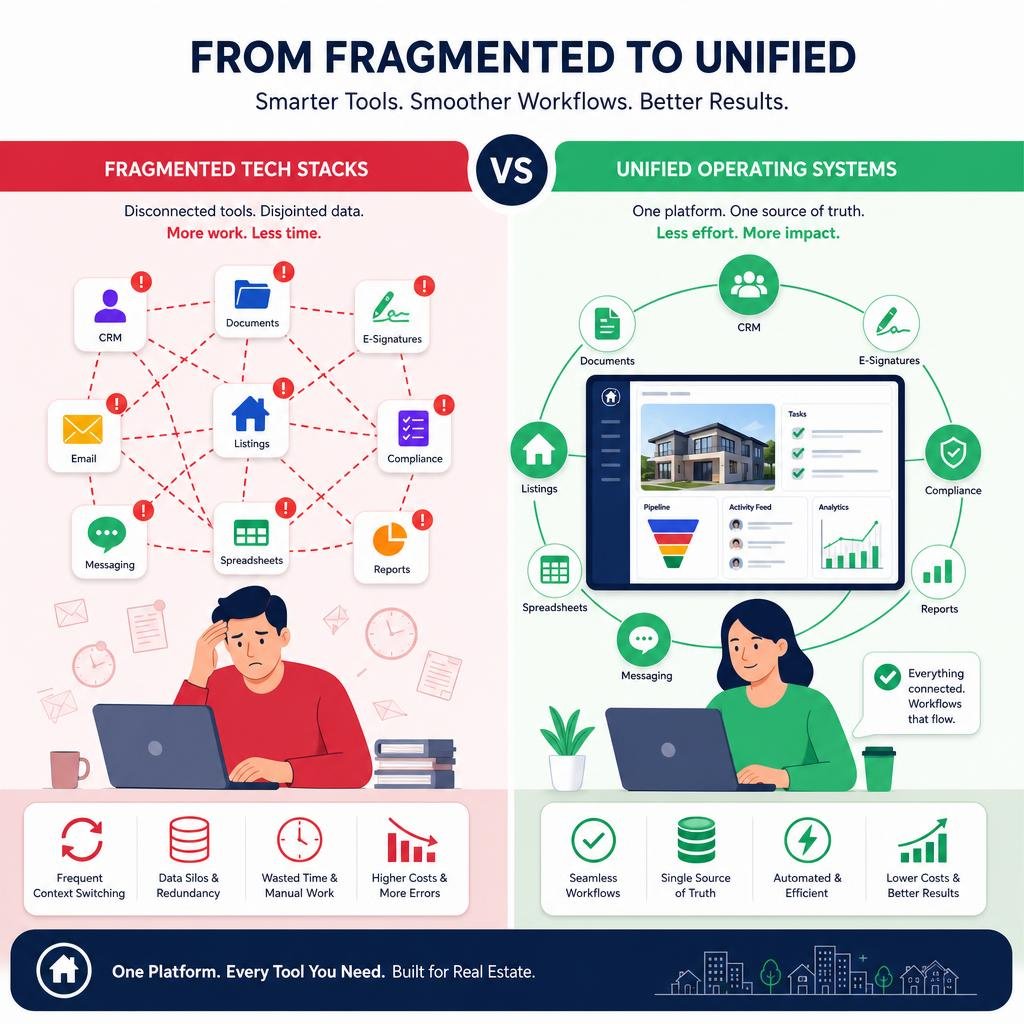
One of the main challenges real estate professionals have historically faced is the proliferation of disconnected tools. Agents often found themselves using separate applications for CRM, marketing, transaction management, e-signatures, and communication – a phenomenon known as a “fragmented tech stack.” This leads to significant “context switching,” where agents constantly jump between different systems, losing time and focus.
This operational “drag” is a real competitor to an agency’s growth. It results in missed follow-ups, lost leads, and a general inefficiency that hinders scalability. The average realty team, for example, might use a CRM, a transaction manager, a forms tool, a commission spreadsheet, an e-sign vendor, and group texts that simply don’t integrate. This “alphabet soup” of tools, often held together by manual efforts, creates unnecessary complexity. Even large commercial real estate firms like Cushman Wakefield Sage Partners recognize the need for streamlined operations to maintain their competitive edge.
The solution lies in unified operating systems – platforms built from the ground up to integrate all these functions. These systems provide a single source of truth, where all client data, property information, and communication history are accessible in one place. By eliminating the need to re-enter data or switch between applications, these platforms dramatically improve efficiency. This is where a truly integrated solution, like those offered by Sundera modern real estate solutions, proves invaluable, ensuring smooth operations from start to finish. Whether you’re tracking coming-soon homes in Wewahitchka, FL, or managing a complex portfolio, a unified system ensures consistency and accuracy.
Feature/Metric Fragmented Tech Stacks Unified Operating Systems Data Silos High (data scattered across multiple apps) Low (single source of truth) Context Switching Frequent (agents constantly switch between tools) Minimal (all tools accessible from one interface) Operational Costs High (multiple subscriptions, integration efforts) Lower (single subscription, reduced IT overhead) Efficiency Low (manual data entry, redundant tasks) High (automated workflows, reduced manual effort) Collaboration Challenging (lack of shared real-time information) Seamless (shared dashboards, real-time updates) Agent Adoption Often low (steep learning curve for multiple systems) Higher (intuitive design, integrated experience) Error Rate Higher (manual data transfer, inconsistent processes) Lower (automated checks, standardized workflows) Scalability Difficult (adding new tools increases complexity) Easier (platform designed to grow with the business)
Reducing Operational Costs with Integrated Systems
The financial benefits of moving to an integrated platform are substantial. While the initial investment might seem significant, the long-term cost reduction and improved efficiency far outweigh it. By consolidating multiple tool subscriptions into a single platform, brokerages can achieve a significant reduction in monthly expenses – some reports suggest a 47% cost reduction.
Beyond direct cost savings, integrated systems lead to:
- Resource Optimization: Agents spend less time on administrative tasks and more time on revenue-generating activities like client interaction and deal negotiation.
- Streamlined Training: Training agents on one comprehensive system is far more efficient than teaching them to navigate a dozen different applications.
- Reduced IT Overhead: Managing a single platform typically requires less IT support and troubleshooting compared to maintaining compatibility between numerous disconnected tools.
This allows brokerages to reinvest savings into growth initiatives, agent development, or even offer more competitive commission structures. For example, managing a portfolio of modern homes in Longmont, CO or overseeing new construction in Sunny Isles Beach becomes more financially viable and less administratively burdensome with a unified system.
Enhancing Client Engagement with Modern Real Estate Solutions
The success of any real estate professional hinges on client satisfaction. Modern real estate solutions are designed to elevate the client experience through enhanced communication, personalized service, and intelligent matching capabilities.
- Real-time Collaboration: Platforms allow for protected collaborative spaces where agents and clients can share listings, provide feedback, and track progress in real-time. Clients can see their agent’s activity and vice-versa, fostering transparency and trust.
- Property Matching: AI-powered property matching goes beyond basic filters. It uses semantic search and predictive analytics to understand a client’s true intent and behavioral preferences. For example, a buyer searching for a “quiet neighborhood near good schools with a modern kitchen” will receive relevant results even if listings don’t use those exact keywords. AI can also analyze visual preferences, matching buyers with homes based on architectural style or interior finishes seen in photos. This is particularly useful when dealing with a diverse range of properties, including foreclosure properties in Montgomery County, TX.
- 24/7 Client Engagement: AI assistants can handle initial inquiries, qualify leads, and provide instant information around the clock, ensuring clients receive prompt responses regardless of business hours. This immediate gratification significantly boosts client satisfaction.
The result is a more engaged, informed, and satisfied client base, leading to higher closing rates and stronger referral networks.
Frequently Asked Questions
As the real estate industry continues its rapid technological evolution, many common inquiries arise regarding the adoption and impact of modern solutions. We aim to address some of these key questions to provide clarity on industry standards and the benefits of technology adoption.
How do modern real estate platforms improve transaction efficiency?
Modern real estate platforms drastically improve transaction efficiency through several integrated functionalities. Firstly, workflow automation digitizes and streamlines repetitive tasks, such as generating contracts, scheduling inspections, and sending reminders. This minimizes manual errors and ensures that critical deadlines are met consistently. Secondly, robust document management systems allow for secure storage, easy retrieval, and version control of all transaction-related documents. Combined with integrated e-signature capabilities, this eliminates the need for physical paperwork and speeds up the signing process. Finally, centralized communication hubs within these platforms ensure that all stakeholders – agents, clients, lenders, and title companies – can communicate and share information within a single, secure environment, reducing miscommunication and delays. This end-to-end integration means that a process that once took weeks of back-and-forth can now be completed in a fraction of the time, with greater accuracy and transparency.
What role does AI play in property matching and client engagement?
AI plays a transformative role in both property matching and client engagement by moving beyond traditional keyword-based approaches. In property matching, AI utilizes advanced algorithms like semantic search to understand the intent behind a buyer’s query, rather than just matching exact keywords. For example, if a client searches for a “family-friendly home with a spacious yard,” AI can identify properties that align with these concepts, even if the listing descriptions don’t use those precise phrases. Furthermore, AI analyzes client behavioral preferences – their browsing history, saved listings, and interactions – to dynamically recommend properties that are a highly accurate match. This predictive capability significantly reduces the time clients spend sifting through irrelevant listings. For client engagement, AI powers 24/7 virtual assistants that can answer common questions, qualify leads, and provide instant information, ensuring clients receive prompt and consistent support. It also helps agents personalize communication by analyzing past interactions and suggesting the most effective follow-up strategies.
How can independent brokers leverage these solutions to scale?
Independent brokers can leverage modern real estate solutions to scale their businesses effectively by adopting tools that offer the capabilities of larger firms without the overhead. Boutique brokerage tools within these platforms are often designed with flexibility and cost-effectiveness in mind, allowing independent agents to access enterprise-level features. These solutions provide shared databases for leads, contacts, and property information, enabling seamless collaboration if an independent broker chooses to build a small team. They also offer robust CRM, marketing automation, and transaction management features that allow independent brokers to manage a larger volume of clients and deals than would be possible with manual processes. The ability to automate tasks, generate personalized marketing campaigns, and track every aspect of their business from a single dashboard provides a powerful foundation for cost-effective scaling, allowing independent brokers to compete effectively and expand their reach without incurring prohibitive expenses.
Conclusion
As we’ve explored, the real estate industry in 2026 is defined by innovation and integration. The shift towards modern real estate solutions is not merely about adopting new tools; it’s about fundamentally rethinking how we operate to deliver unparalleled value to clients and achieve sustainable growth. From AI-powered lead management and unified operating systems to streamlined transaction workflows and enhanced client engagement, these advancements are reshaping the landscape for brokers and agents alike.
The challenges posed by fragmented tech stacks are being overcome by comprehensive platforms that reduce costs, improve efficiency, and foster collaboration. Top-performing brokerages and teams are already leveraging these technologies for deeper market insights, robust compliance, and scalable business models. For independent brokers and large agencies, the right modern solution provides the competitive edge needed to thrive in a dynamic market.
The future of real estate is intelligent, integrated, and client-centric. Embracing these modern solutions is no longer optional but essential for success. We encourage all real estate professionals to evaluate their current tech stacks and consider how a unified, AI-powered platform can transform their business. Explore options that help you understand your financial capacity, like a house affordability calculator, and find properties across various regions through comprehensive directories like the ez Home Search US directory. The journey to a more efficient, profitable, and satisfying real estate career begins with the right technology.

Built on the Hottest Solana Launchpad https://memefast.pages.dev
Fresh Phone Data for Marketing Agencies https://datadigi.pages.dev
Experience the Joy of Building Together in Our Shared Survival Multiplayer World https://dllink.pages.dev/kitty