Nipple Shields for Breastfeeding: When They Help and When They Hurt Supply
A nipple shield gets recommended at 2 a.m. in the NICU, or by a lactation consultant who has watched a baby struggle for twenty minutes and decides that getting the baby fed matters more than perfect technique. It works. The latch succeeds, the pain drops, and milk actually transfers. Then the question nobody warned you about comes up: how long is this supposed to last, and what is it doing to your supply?
Those two concerns — the effect on milk production and the path off the shield — are exactly where most nipple shield breastfeeding guides go quiet. This one doesn’t.
This article is for general information only and is not a substitute for advice from your healthcare provider or a certified lactation consultant.

Table of Contents
- When a nipple shield actually makes sense
- Nipple shield sizes and how to get the fit right
- How nipple shields can affect milk supply
- Using a pump when using a shield
- A practical guide to nipple shield weaning
- Conclusion
When a nipple shield actually makes sense
At its core, a nipple shield solves a mechanical problem. It gives a flat, inverted, or very short nipple a shape the baby can latch onto. It creates a firmer target for a preterm baby who hasn’t yet developed the jaw strength to draw in soft tissue. For parents dealing with severe nipple trauma — cracked, bleeding, raw from repeated shallow latches — it can be the difference between continuing and stopping altogether.
The Academy of Breastfeeding Medicine (ABM) identifies several clinical indications: prematurity, latch difficulty secondary to nipple anatomy, and short-term trauma management. That list is narrower than how shields are actually used in practice — a shield won’t fix tongue restriction, oral motor dysfunction, or a positioning error. It helps the feed happen without addressing what’s causing the difficulty. A lactation consultant is the right call before reaching for one unless a provider has already made the recommendation.
Cases where the shield most clearly earns its place:
- Preterm babies who cannot yet generate suction on flat tissue
- Flat or inverted nipples where the baby loses the breast repeatedly mid-feed
- Nipple pain severe enough that feeds are being shortened or skipped
- Babies moving from bottle to breast who have developed a preference for a firmer nipple shape
Nipple shield sizes and how to get the fit right
A shield that doesn’t fit correctly creates problems on both ends. Too small and the nipple rubs against the silicone wall with each feeding cycle — pain that can be as bad as nursing without one. Too large and the baby gets a target too wide to compress well, which means poor transfer and inadequate stimulation to the breast tissue beneath.
Nipple shield sizes are measured by the internal diameter of the tip in millimeters. Standard sizes run 16 mm, 20 mm, and 24 mm, with some manufacturers offering 28 mm or 31 mm for larger nipples. Sizing is based on nipple diameter, not breast size.
A practical starting point:
- Measure the diameter of the nipple at its widest point, at rest
- Add 2–3 mm to that figure
- The resulting number is roughly the shield size that leaves the nipple free to move without friction against the sides
The nipple should draw fully into the tip during a feed without touching the walls. After a session, a nipple that comes out white, flattened, or painful means the shield is too small. Clicking, slipping, or minimal engagement at the base is a sign the shield is too large — try the next size down.
Fit matters for supply, not just comfort. A poor fit means incomplete nipple stimulation and weaker let-down signals — a production problem that builds slowly enough that the connection isn’t obvious until weeks later.
How nipple shields can affect milk supply
The shield itself isn’t the variable that matters most. When the shield fits correctly and the baby has adequate jaw strength and feeds consistently, supply can be maintained without issue. The problem shows up in a specific combination: poor fit, a weak suck (common in prematurity), or feeds that don’t fully empty the breast. Supply is regulated by how much milk is removed over a given window — if the shield reduces transfer efficiency, the breast receives a weaker signal to keep producing.
A review in Breastfeeding Medicine found that shield use did not consistently lower supply when fit and feeding frequency were maintained. The variable that mattered was transfer volume — shields linked to lower supply were also linked to lower infant weight gain, meaning the baby wasn’t draining well rather than the shield causing a drop on its own.
What this means day-to-day:
- Watch the baby’s output. Wet and dirty diapers are the earliest signal that transfer is happening — or isn’t.
- Follow weight gain at pediatrician appointments. Stalled gain is a reason to call a lactation consultant, not to wait.
- If feeds consistently end without the breast feeling noticeably softer, a short pump session afterward can close the gap.
Using a pump when using a shield
Supplemental pumping during shield use is one of the clearest ways to protect supply — and to catch a gap in drainage before it quietly becomes a supply problem.
The goal isn’t to replace nursing, but to finish what the nursing session may have left undrained. A 10–15 minute session after nursing — particularly when the baby tired out early or lost the shield mid-feed — gives the breast an additional emptying signal and tends to prevent the gradual supply dip that sometimes appears by week six or eight.
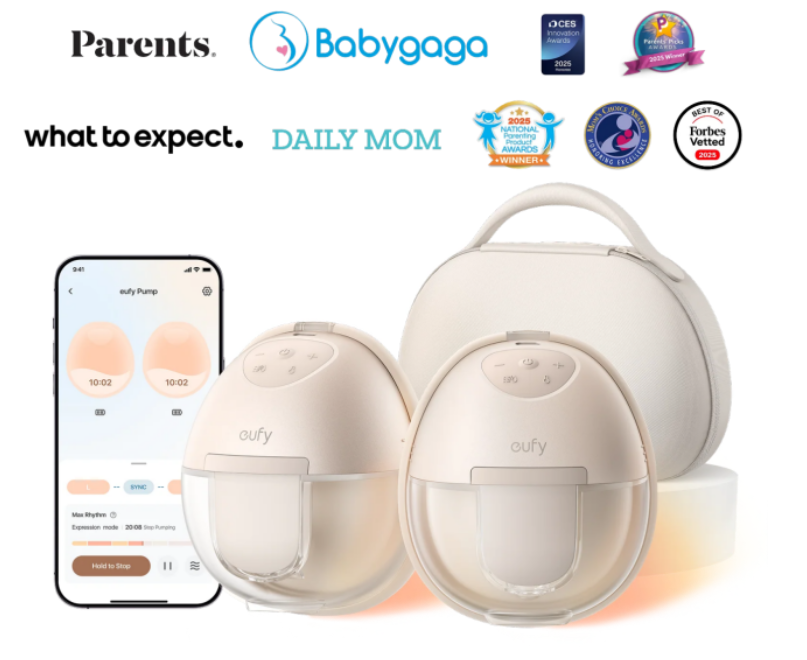
Suction control matters here more than raw output settings. The point of a post-nursing pump isn’t maximum extraction — it’s finishing what the baby started. Starting at a gentle rhythm and increasing only as needed is enough — and avoids the kind of extra discomfort that anyone already dealing with nipple soreness really doesn’t need. The eufy Breast Pump S1 Pro handles this setup well: the OptiRhythm™ system through the eufy Baby app lets you adjust suction and rhythm independently, so sessions can stay gentle at the start and increase only as comfort allows. The HeatFlow™ warming function (95°F–105°F) supports let-down at the beginning of a session, which makes a short supplemental pump session easier to complete without a long warm-up period.
A practical guide to nipple shield weaning
Nipple shield weaning goes better when it isn’t rushed. The right time is when the baby has gained well, feeds are smooth, and the original reason for using a shield — prematurity, anatomy, trauma — has improved. There should be at least a few stretches each day when the baby is calm and hungry but not frantic.
A graduated approach
Start with one feed per day without the shield. The early morning session tends to work best — the breast is full, let-down comes fast, and the baby gets a reward before frustration builds.
If the first attempt doesn’t go well, try the next day. Some babies move off within a week; others take three to four weeks of consistent attempts.
A pattern that tends to work:
- Begin the feed without the shield and stay with it through fussing for about 60–90 seconds
- If the baby hasn’t latched, bring in the shield and finish the feed — hunger escalating into distress makes the next attempt harder
- Add a second shield-free attempt the next day before the first feels reliable
- Once two consecutive feeds per day are holding, extend to three, then to most feeds over the following week
What can stall weaning
Long-term shield use creates habituation — the baby’s only reference point for nursing is a firm silicone shape. Flat or inverted anatomy that hasn’t improved enough to give the baby something to grip is another common block. If the areola is engorged and too firm, a short hand expression before the attempt can soften it enough to help. A less obvious stall: tongue restriction that the shield was masking. If the baby latches without the shield but causes consistent pain or slides off repeatedly, an oral assessment before continuing is worth scheduling.
If progress stalls after three to four weeks of daily attempts, a lactation consultant follow-up is the right move.
Conclusion
A nipple shield is a bridge, not a permanent structure. In the right situation, fitted correctly, with transfer kept in check, it protects the breastfeeding relationship through a difficult early stretch. Supply concerns are real but manageable — they mostly appear when poor transfer or extended use without oversight creates a gap between what the baby removes and what the body needs to keep producing. A few millimeters of fit in the wrong direction compounds every problem the shield was supposed to solve.
Weaning usually goes better than expected when it starts before the habit is deeply set and the switch is gradual. If supplemental pumping is part of what’s keeping supply stable through that period, the eufy breast pump collection includes options built for precise, adjustable sessions — the kind that work best when you’re managing output rather than just maximizing it.
